How Do I Negotiate a Severance Package When I Am Being Laid Off Without an HR Background?
Your first severance offer is almost never the final one. Here's exactly how to counter it—without an HR background or a lawyer on speed dial.
Short answer
Almost every severance offer is a starting point, not a final number, because the company needs your signature on a legal release of claims and that signature has real value. Ask for at least 48 hours to review the offer before you say or sign anything. Then counter in writing, requesting two to four extra weeks of pay per year of service, continued health benefits, and a neutral reference agreement. You do not need an HR background—you need a short checklist and the nerve to send one polite email.
Why the Company Needs Your Signature More Than You Realize
A severance offer is almost always attached to a release of claims—a legal document where you waive your right to sue the company for wrongful termination, discrimination, wage violations, or anything else that might apply. That release is the point. If you walk out without signing, they get nothing. That asymmetry is the reason you have more negotiating room than you feel right now, sitting across from HR with a folder in your hands.
Three Things Not to Do in the First Meeting
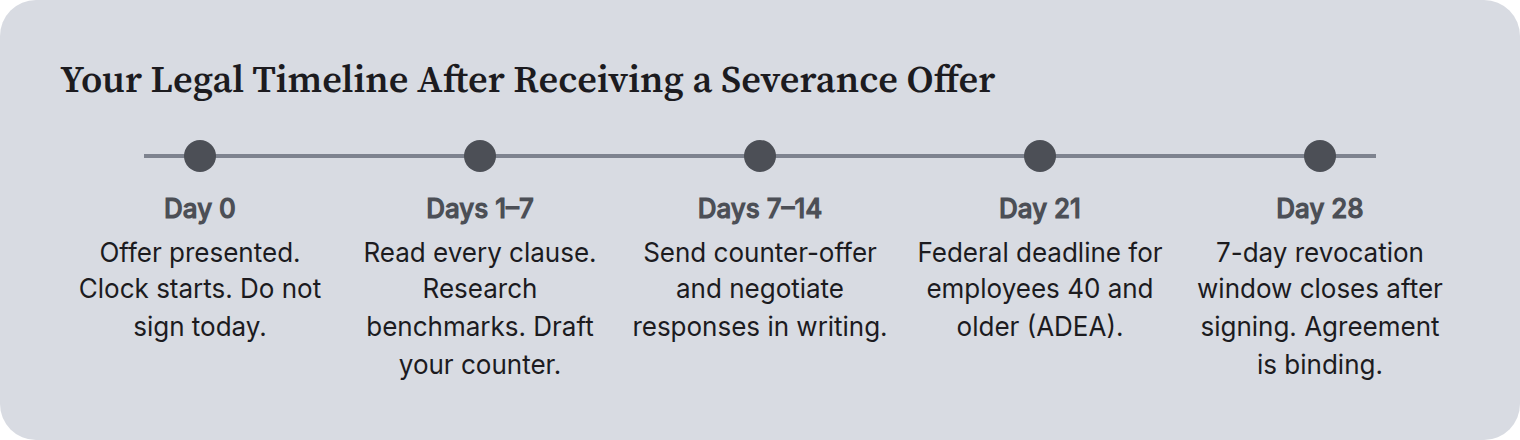
- Do not sign anything that day. Under federal law, you have at least 21 days to review a release (45 days in a group layoff if you're over 40). The clock doesn't start until they hand you the document.
- Do not show panic or anger. The person across the table is often not the one who made this call, and hostility closes doors you may need later.
- Do not accept verbally. 'This sounds reasonable' weakens your position even if you haven't signed. Say something calm: 'I'd like a couple of days to review this before I respond.'
The only thing you need to say in the room
"Thank you for walking me through this. I'd like 48 hours to review the offer carefully. Can you send me the full agreement in writing?" That's it. Nothing else is required of you today.
What a Fair Counter-Offer Looks Like (With Real Numbers)
Say you've been at the company four years, earning $80,000 a year—about $1,538 a week. A typical opening offer is one week per year of service, so four weeks, or roughly $6,154. That's the floor, not the target. A reasonable counter for someone at your tenure is two to three weeks per year, putting you at eight to twelve weeks—$12,308 to $18,462. That range is standard at mid-size companies and not an outlandish ask.
Beyond the base number, there are four levers worth pulling.
- Extra weeks of salary. The headline number and the most negotiable. Ask for two to four additional weeks per year of service on top of what they offered.
- Health insurance continuation. COBRA often runs $600–$800 a month for a single person. Ask the company to cover your premiums for 30 to 60 days. Many will agree to 30 without much pushback.
- Equity or unvested options. If you're close to a vesting cliff, ask about accelerated vesting or an extended exercise window. This gets overlooked constantly and can be worth thousands.
- Reference language in writing. Ask for a clause stating the company will confirm only your title, dates of employment, and rehire eligibility—written into the agreement, not promised verbally.
The Counter-Offer Email: Keep It Short
Three paragraphs. You are not writing a legal brief. Paragraph one: thank them and acknowledge the offer. Paragraph two: make your ask with specific numbers—'I'd like to request twelve weeks of base salary in place of the four weeks offered, continuation of health benefits through [date], and a written reference clause limiting disclosure to title, dates, and rehire eligibility.' Paragraph three: say you're committed to a smooth transition and hope to reach an agreement that works for both sides.
Specific numbers in writing are harder to ignore than vague verbal requests. The email gives HR something concrete to take to their manager and removes the emotional weight of an in-person back-and-forth.
Mistakes That Kill the Negotiation Early
- Threatening to sue. Unless you have a real claim and a real attorney, this hardens their position fast. Mentioning you'd like an employment lawyer to review the release is professional and normal. Threatening litigation is different.
- Too many asks at once. Pick your two most important items. Eight demands feel like an attack.
- Making it personal. 'I've given everything to this company' is not a negotiating argument. 'My tenure and the industry standard for severance' is.
- Waiting too long. Counter within five to seven business days. Using all 21 days can signal you've disengaged.
Your Next 48 Hours
- Get the full agreement in writing before you leave—note the date you received it.
- Check your state's rules. Some states add protections beyond federal minimums.
- Review your original offer letter and employee handbook for any existing severance language.
- List every active benefit: health, dental, FSA, stock, unused PTO. In many states, accrued PTO is earned wages owed to you regardless of severance.
- Draft your counter-offer email before you sleep on it twice. Clarity fades when stress sets in.
- If the package is large or your situation feels complicated, a one-hour consult with an employment attorney ($200–$400) often pays for itself.
The fear that asking for more will cost you a good reference or make things legally worse is almost always unfounded. A polite, written counter-offer is normal and expected. The risk of asking is low. The cost of not asking is usually several thousand dollars you left on the table.
Questions people also ask
Will asking for more severance hurt my reference?
It's unlikely. HR professionals see counter-offers routinely and a polite written request is not threatening. If the reference is your main concern, make a neutral reference clause one of your explicit asks and get it written into the agreement.
What if my company says the offer is non-negotiable?
Ask if you can have a day to review it anyway. Most 'policies' are not actually policies. Even when base pay is fixed, health coverage continuation, reference language, and payment timing often have flexibility the first conversation doesn't reveal.
Do I need a lawyer to negotiate severance?
Not always. A one-hour consult is worth it if your package exceeds $25,000, if the release language is unusually broad, or if you suspect a discrimination or wrongful termination claim. Many employment attorneys offer flat-fee document reviews.
Can I negotiate if I was laid off as part of a large group reduction?
Yes. Group layoffs trigger ADEA protections that give you 45 days to review the release instead of 21. Being in a group doesn't lock your individual terms—you can still counter on weeks of pay, benefits, and reference language.
What happens to my health insurance the day I'm laid off?
Employer-sponsored coverage typically ends at the end of the month you're terminated, though this varies. You'll be offered COBRA at the full premium plus a 2% admin fee. Negotiating for the company to cover even 30 to 60 days of premiums can save you $1,000 or more.
The Full Guide
Walk Away With More Money When You're Getting Laid Off

- A word-for-word counter-offer email template you can customize and send in under 20 minutes
- Worked scenarios for five different tenure lengths and salary levels showing realistic ask ranges and likely outcomes
- A pre-signing checklist that walks through every clause of a standard separation agreement so nothing slips past you