What Is the Correct Order to Pay Off Debt and Invest When I Have a 401k Match, Credit Card Debt, and a Student Loan Simultaneously?
Juggling a 401k, credit cards, and a student loan at once? Here's the exact sequence to follow so you don't leave free money on the table or drown in interest.
Short answer
Start by contributing just enough to your 401k to capture every dollar of your employer match — that instant 50–100% return beats everything else. Then throw everything extra at your credit card debt, because 20%+ interest is a guaranteed loss no investment reliably outpaces. Once the cards are gone, you can tackle your student loan and grow your 401k contributions at the same time, since student loan rates are usually low enough that doing both simultaneously still builds long-term wealth.
Most people in this situation don't have a math problem. They have a sequencing problem. They're putting $200 here, $150 there, a little toward the loan, a little toward the card, and wondering why nothing moves. The issue isn't the amounts. It's that every dollar is fighting every other dollar with no clear chain of command.
The order you pay things off in actually changes the outcome, sometimes by tens of thousands of dollars over a decade. So let's build the chain of command.
Step 1: Contribute Exactly Enough to Get Every Dollar of Your 401k Match
Before you pay a single extra dollar toward any debt, find out what your employer match looks like. A common structure: your company matches 50% of your contributions up to 6% of your salary. If you earn $60,000, that means contributing $3,600 a year (6%) earns you $1,800 from your employer, free. That's a 50% instant return before the market does anything.
Some employers match dollar-for-dollar up to 4%. That's a 100% return on those dollars. Nothing, not paying off debt, not index funds, not anything else, gives you that. Walking away from the match because you're trying to kill debt faster is like turning down a raise.
Find your number before anything else
Log into your HR portal or benefits platform and look up the exact match formula. Then calculate the minimum contribution percentage that captures the full match. Set that contribution first. Everything else comes after.
That's all you do with the 401k for now. Don't try to max it out while carrying credit card debt. Just get the match and move on.
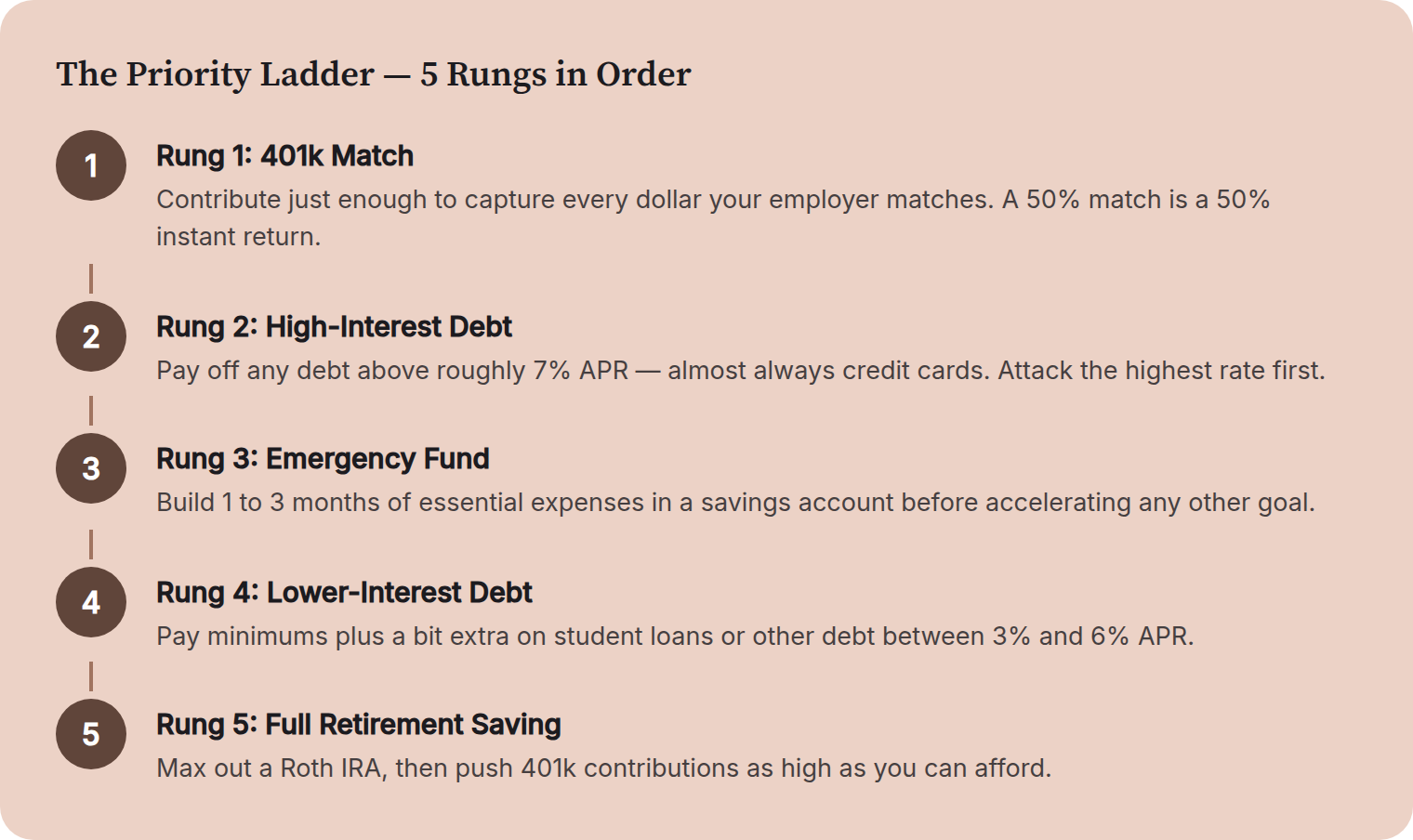
Step 2: Destroy the Credit Card Debt
Credit card interest rates are typically 20 to 29% right now. Think about what that means in practice: for every $1,000 you carry on a card at 24% APR, you're paying $240 a year just to stand still. The S&P 500 averages roughly 10% annually over long periods. Even in a great year, the market rarely beats 24%. Paying off a 24% card is, mathematically, a 24% guaranteed return.
So after you've locked in your match contribution, every available dollar goes to the credit cards. Use the avalanche method (highest interest rate first) to minimize the total cost. Or use the snowball method (smallest balance first) if you need the psychological wins to stay motivated. Either works. Stopping is the only thing that doesn't.
Do not invest beyond the match while carrying double-digit credit card debt. I know that feels counterintuitive when everyone is talking about compound interest and Roth IRAs. But you cannot out-invest 24% interest. It's not possible.
Step 3: Student Loans and More Investing — You Can Actually Do Both
Here's where the decision gets more nuanced. Once the credit cards are gone, you free up real money every month. The question is whether to hammer the student loan or redirect that cash toward investing.
Student loan interest rates matter a lot here. Federal loans originated in the last few years typically carry rates between 5 and 7%. Private loans can be higher. The general rule: if your loan rate is below 6 to 7%, you can reasonably invest the difference while making standard loan payments, because long-term market returns have historically exceeded that threshold. If your rate is above 7%, treat it more like the credit card and pay it aggressively before investing beyond the match.
At this stage, I'd also start increasing your 401k contribution toward the annual maximum ($23,500 in 2025) and consider opening a Roth IRA if your income qualifies. The student loan isn't going anywhere fast, but retirement accounts have annual contribution windows you can never go back and fill.
A Real Numbers Example: $500 Extra Per Month
Say you bring home $4,000 a month after taxes and you have $500 left over after rent, food, and minimum payments. Here's how that $500 flows through the three steps.
- Your employer matches 100% of contributions up to 4% of salary ($60,000). That's $2,400 a year, or $200 per month from your paycheck. You're already doing this, so Step 1 is handled. You have $300 left to work with.
- You have two credit cards: one with a $3,200 balance at 22% and one with an $800 balance at 18%. You put all $300 per month toward the $800 card first (snowball) or the 22% card first (avalanche). Either way, you're debt-free on both cards in roughly 12 to 14 months.
- Cards gone. Now you have $300 per month back. Your student loan is $18,000 at 5.5%. You split: $150 goes to extra loan payments and $150 goes toward increasing your 401k contribution. Your loan is paid off years ahead of the standard 10-year schedule, and your retirement balance keeps compounding.
That's not a perfect plan for everyone, and your numbers will differ, but the shape of it holds. The sequence is what creates the momentum.
Three Mistakes That Keep People Stuck
- Splitting money evenly across all three at once. This feels balanced but it's actually slow everywhere. The credit card interest keeps compounding, the 401k grows too slowly, and the loan barely shrinks. Prioritize in sequence, not in parallel.
- Skipping the employer match to pay debt faster. Every dollar of match you forfeit is a dollar of free compensation you never get back. Capture it first, always.
- Overpaying a 5% student loan while ignoring the 401k. A 5.5% loan rate is manageable. Skipping years of tax-advantaged compounding to pay off low-rate debt early can actually cost you more over 30 years than the interest you saved.
Your Move This Week
Pick one thing. Just one.
If you don't know your employer match formula, find it today. Check your HR portal, your benefits email, or call HR directly. That's the only number that matters right now. Once you have it, set your 401k contribution to exactly capture the full match if you haven't already. Then look at your credit card interest rates and identify which card gets the first attack.
You don't need to solve the student loan this week. You don't need to open a Roth IRA this week. You need one number, one account setting, and a clear head about what comes next. The sequence does the heavy lifting. Your job is to start it.
The anxiety is usually about making the wrong choice forever. But this is a sequence, not a life sentence. You can adjust as your situation changes. Getting started in roughly the right order beats waiting for the perfect moment every single time.
Questions people also ask
Should I pause my 401k contributions entirely to pay off credit card debt faster?
Only down to the minimum that captures your full employer match, never below that. Forfeiting matched contributions means giving up guaranteed compensation, and the credit card payoff math doesn't justify it. Beyond the match, yes, redirect extra toward the cards first.
What if my student loan interest rate is 7.5% or higher — does that change the order?
Yes. At rates above roughly 7%, the guaranteed return from paying off the loan starts to compete seriously with expected investment returns. In that case, treat the student loan as a priority after the credit cards and delay boosting your 401k beyond the match until the loan is gone or refinanced to a lower rate.
Can I open a Roth IRA while still paying off debt?
Technically yes, but sequentially it belongs after the credit cards are cleared. If your student loan rate is low and your cards are gone, contributing to a Roth IRA alongside standard loan payments is a reasonable move, especially because Roth contribution limits don't roll over and the tax-free growth window is long.
What if I can't afford to even make minimum payments on everything?
That's a cash flow problem before it's a sequencing problem. Call your federal student loan servicer about income-driven repayment plans, which can lower your required monthly payment significantly and free up cash to address the credit cards. Income-driven repayment is not failure — it's a tool.
How do I know when I've actually finished Step 2 and should move to Step 3?
When every credit card has a zero balance and you've cancelled or frozen the ones you don't plan to use responsibly. Don't count a card as paid off if you're still using it and carrying a balance. The finish line is a genuine zero.
The Full Guide
The Exact Order to Crush Debt and Build Wealth Simultaneously

- A month-by-month payoff tracker that shows exactly how your $500 (or any amount) moves through each step until the cards and loan are gone
- A side-by-side scenario calculator comparing three common interest rate combinations so you can find your exact student loan tipping point
- A one-page decision checklist for when to increase your 401k, open a Roth IRA, and refinance your student loan, with the income and rate thresholds that trigger each move