How Do I Create a Debt Payoff Plan When I Have Both Medical Debt and Credit Card Debt at the Same Time?
Medical debt and credit card debt play by different rules. Here's how to separate them, negotiate what you can, and build a realistic payoff plan.
Short answer
Medical debt rarely charges interest and, as of 2025, is largely excluded from credit reports, so it's less financially urgent than credit card debt that compounds daily and directly damages your score. Call your medical provider first to negotiate a zero-interest payment plan or hardship reduction, then direct the rest of your monthly budget at credit cards using the avalanche or snowball method. List every balance, minimum payment, and interest rate in one place, assign every available dollar a job, and pay at least something on each debt every month to keep accounts in good standing.
Why These Two Debts Play by Completely Different Rules
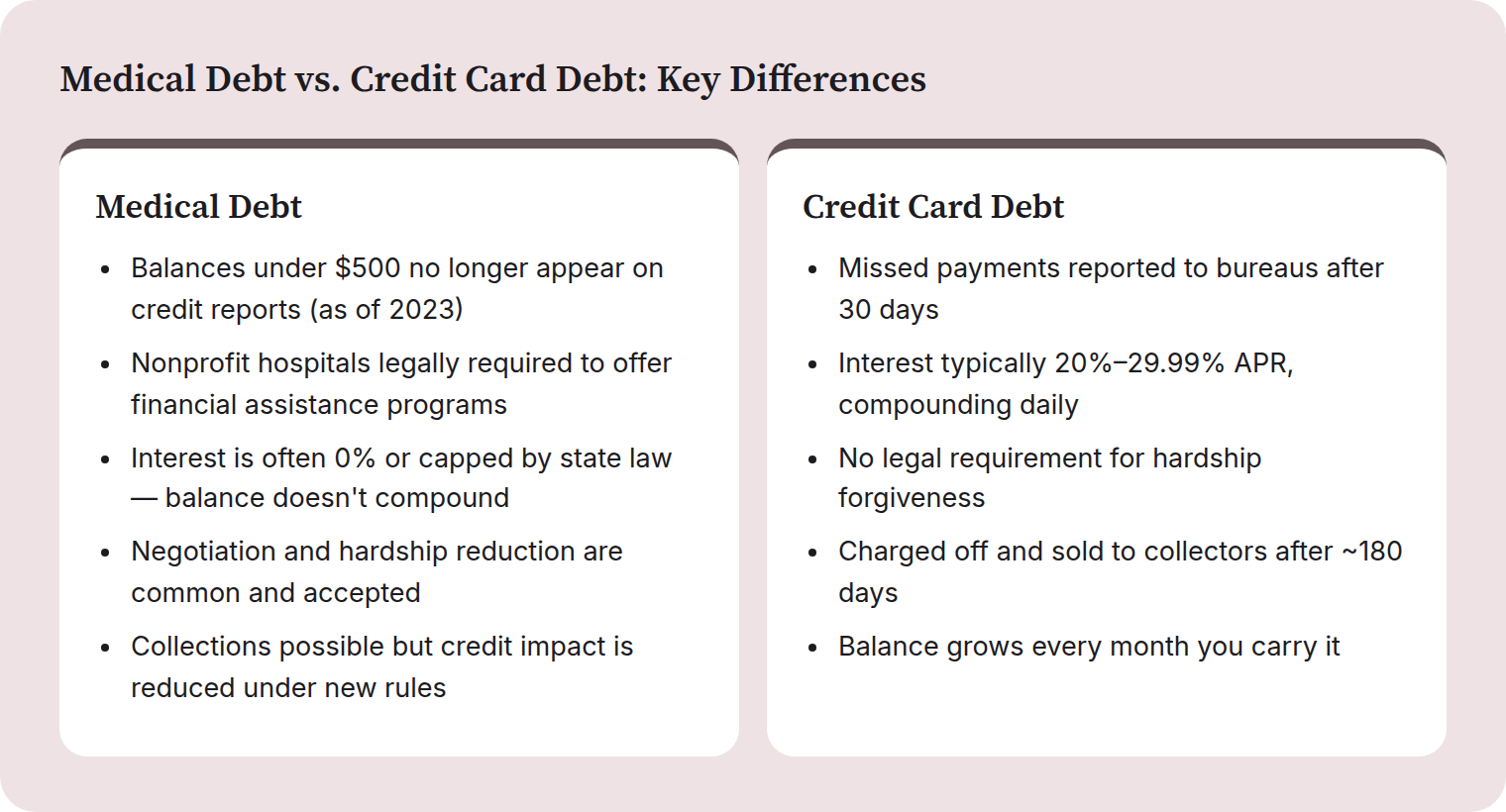
Credit card debt compounds. Many cards charge 20% to 29% APR, calculated daily. A $4,000 balance at 24% APR costs roughly $80 in interest every single month you carry it. Miss a payment and it shows up on your credit report within 30 days, where it can sit for seven years.
Medical debt is different in almost every way. Most hospitals don't charge interest on unpaid balances. Since 2023, the three major credit bureaus stopped including most medical debt on credit reports, and 2025 CFPB guidance pushed that further. A $2,000 hospital bill on a payment plan is not silently wrecking your score the way a maxed-out credit card is.
The key distinction
Medical debt: typically zero interest, largely off credit reports, often negotiable. Credit card debt: daily compounding interest, directly scored, non-negotiable rate unless you call and ask. Treat them differently from the start.
Step 1 — List Everything in One Place
Before paying a single dollar toward anything, write out four columns for every debt you carry: who you owe, the current balance, the interest rate, and the minimum payment. Spreadsheet, notebook, back of an envelope — format doesn't matter. Visibility does. Vague debt feels infinite. Named, numbered debt is something you can actually work with.
Step 2 — Call the Medical Provider Before You Pay
Most people skip this step, and it's the one that can save the most money. Call the billing department specifically and say: 'I want to pay this bill, but I'm also managing credit card debt right now. What payment plans or hardship options do you offer?' Many hospital systems have charity care programs that reduce or eliminate bills based on income. Even without that, most providers will accept $25 to $50 a month at zero interest. Get any agreement in writing before you send money.
If your bill is already in collections, you can still negotiate. Medical debt collectors often settle for less than the full balance, especially for a lump sum. I'd start by asking if they'll take 50 cents on the dollar. The worst they say is no.
Step 3 — Attack Credit Cards with a Real System
Once medical bills are on a manageable plan, direct the rest of your budget at credit cards. Two methods worth knowing: avalanche targets the highest interest rate first and saves the most money. Snowball targets the smallest balance first for the psychological win of eliminating a debt entirely. Either works. The best one is whichever you'll actually stick with.
A real example with $800 a month
- Medical bill: $3,200 total, zero interest, payment plan at $50/month
- Credit Card A: $4,500 balance, 27% APR, $90 minimum
- Credit Card B: $1,800 balance, 19% APR, $45 minimum
Total minimums plus medical plan: $185. That leaves $615 to deploy. Using avalanche, all $615 goes to Card A — the 27% card. At $705 per month total toward Card A, it's gone in about seven months, saving over $600 in interest versus minimums only. Then the full $705 rolls to Card B, which clears in a few months. Then everything hits the medical bill, paid off well ahead of schedule. The whole thing moves faster than most people expect once every dollar has a job.
The Most Common Mistake
People put $400 a month toward a hospital bill charging zero interest while paying only minimums on a credit card at 24% APR. The hospital bill feels urgent — maybe because it came from something scary, or the collection letters look official. But that credit card is costing money every single day. The hospital bill is not.
The flip side also happens: people ignore medical bills entirely because they heard medical debt doesn't affect credit. That's mostly true now, but unpaid medical debt can still go to a third-party collector and show up as a collection account. Getting it on a small payment plan costs almost nothing and keeps you out of that situation entirely.
What to Do If There Isn't Enough Money to Pay Both
- Call the medical provider and ask for the lowest possible monthly payment — many accept $25 — or apply for charity care if your income qualifies.
- Pay at least the minimum on every credit card. One missed payment can trigger a penalty rate of 29.99% plus a late fee.
- If you can't make a credit card minimum, call the issuer before the due date and ask for the hardship program. Most major issuers have one. It's not advertised.
- If things are extremely tight, make one full credit card payment on the highest-rate card and contact the others to explain your situation before they miss the payment.
Your Next 48-Hour Action List
- Today: Write down every balance, interest rate, and minimum payment for all debts in one place.
- Today: Calculate what's actually left each month after rent, groceries, and fixed bills.
- Within 48 hours: Call your medical provider's billing department and ask about payment plans, hardship programs, and charity care. Write down the name of whoever you speak with.
- Within 48 hours: Pick avalanche or snowball for your credit cards and identify which card gets the extra dollars first.
- Set a 30-minute reminder for next month to review the plan and adjust if anything has changed.
The plan doesn't have to be perfect to work. It has to be specific enough that every dollar knows where it's going before the month starts.
Questions people also ask
Will medical debt hurt my credit score if I don't pay it right away?
As of 2025, medical debt is largely removed from consumer credit reports, so it's unlikely to affect your score directly. However, a large unpaid balance sent to a third-party collector can still appear as a collection account, so staying in communication with the provider and keeping a payment plan active is the safer move.
Can I negotiate my credit card interest rate the way I negotiate a medical bill?
You can call and ask, and it occasionally works if you have a solid payment history. More reliably, major card issuers offer hardship programs that temporarily lower your rate or waive fees — ask specifically for the hardship or customer assistance department rather than the general line.
What if my medical bill is already in collections?
It's not too late. Medical debt collectors often accept less than the full balance, especially for a lump-sum offer. Start by asking if they'll settle for 50% and get any agreement in writing before sending money.
Should I drain my savings to pay off debt faster?
Keep at least one to two months of expenses in savings before going aggressive on debt — because one unplanned expense without a cushion usually means new credit card charges, which undoes the progress. Once you have that buffer, direct extra cash toward your highest-rate debt.
Does the order matter if my credit card interest rates are close to each other?
If the rates are within two or three percentage points, the math difference is small. In that case, the snowball method — smallest balance first — is probably the better call because eliminating a card entirely simplifies your monthly picture and builds momentum.
The Full Guide
Escape Medical and Credit Card Debt With One Clear Plan

- A fill-in-the-blank debt tracker that calculates your avalanche and snowball payoff timelines side by side
- Three worked scenarios — tight budget, moderate budget, and lump-sum settlement — showing exact month-by-month payoff sequences
- A script checklist for calling medical billing departments and credit card hardship lines, including what to ask for in writing