How Much Coffee Should I Drink Daily to Be Healthy?
Most research points to 3–4 cups a day as the sweet spot. Here is what that actually looks like, why timing matters as much as amount, and how to find your personal limit.
Short answer
For most healthy adults, 3–4 cups of filtered coffee per day—roughly 300–400 mg of caffeine—is where the evidence clusters for benefit, linked to lower risks of type 2 diabetes, liver disease, and cognitive decline. Pushing past 5 cups starts to work against you, raising anxiety, disrupting sleep, and nudging blood pressure upward in people sensitive to caffeine. Timing is nearly as important as quantity: stopping caffeine 6–8 hours before bed protects sleep quality even if your daily total is perfectly fine. Pregnant people, those with heart arrhythmias, and anyone on certain medications have a much lower safe ceiling and should talk to a doctor.
Coffee headlines are almost engineered to confuse you. One week a study says two cups a day cuts liver cancer risk. The next week a cardiologist warns about atrial fibrillation. Both things can be true simultaneously, which is part of why the conversation feels so slippery. Most studies also measure different outcomes and use different definitions of 'a cup.' Once you see that, the noise settles down considerably.
What the science actually says
The most consistent signal across large meta-analyses is that 3–4 cups of filtered coffee per day is associated with real health benefits for healthy, non-pregnant adults. A widely cited 2017 umbrella review in the BMJ—covering over 200 meta-analyses—found this range linked to lower all-cause mortality, reduced type 2 diabetes risk, lower rates of liver cirrhosis and liver cancer, and a modest protective effect against Parkinson's disease. These are associations, not guarantees, but they point in a consistent direction across enough studies to be credible.
Benefits appear to plateau around 3–4 cups. Going higher does not add protection, and above 5 cups the risk side of the ledger starts to grow: more anxiety, worse sleep, raised blood pressure in people who metabolize caffeine slowly. The sweet spot is not a narrow cliff edge—you have room to move around in it—but it is a real range.
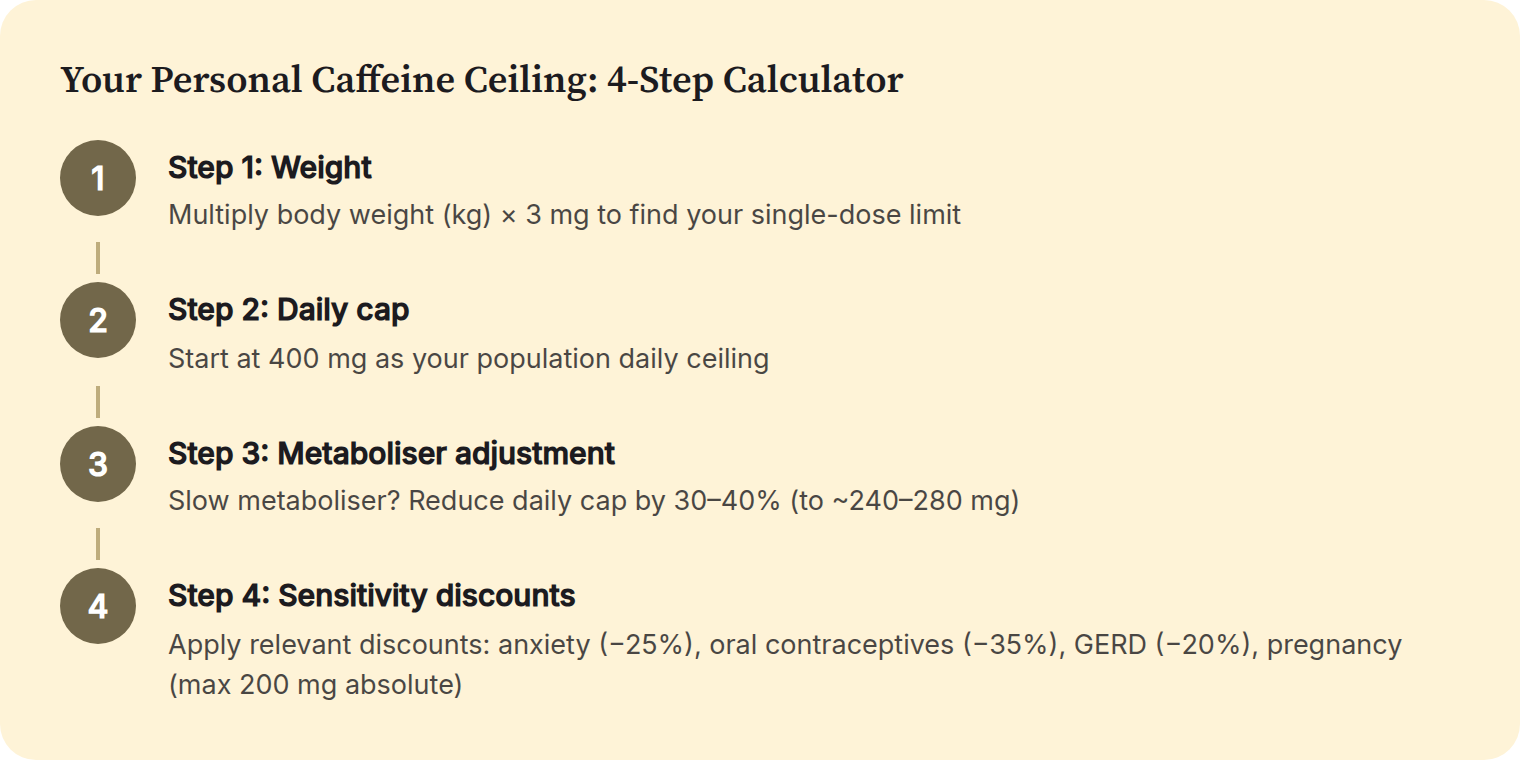
What 400 mg actually looks like
'A cup' means wildly different things depending on how the coffee is made. A standard 8-oz drip coffee runs about 95–120 mg. A single espresso shot is roughly 63 mg. A 16-oz cold brew from a café can hit 200–300 mg on its own.
Say you start with a 16-oz cold brew at 250 mg. That is already more than half your daily budget before 9 a.m. Add a mid-morning drip coffee at 110 mg and you are at 360 mg—still in range. Have a third drip coffee at 3 p.m. and you are at 470 mg, past the upper end, with caffeine actively in your system well into the night. That single scenario explains a lot of people's sleep problems.
- 8-oz drip coffee: ~95–120 mg
- Single espresso shot: ~63 mg
- Double espresso (standard latte base): ~126 mg
- 16-oz cold brew, café-made: ~150–300 mg (check the brand)
- 8-oz green tea: ~25–45 mg (counts toward your total)
The timing rule most people skip
Caffeine has a half-life of roughly 5–6 hours in most adults. Drink a 200 mg cold brew at 2 p.m. and you still have about 100 mg active at 8 p.m.—enough to reduce sleep quality even if you fall asleep without trouble. Light sleep is not the same as restorative sleep. The next day you feel sluggish, reach for coffee earlier, add that afternoon cup again, and the cycle continues.
The practical cutoff most sleep researchers recommend is 6 hours before your target bedtime, with 8 hours as the safer buffer for slow metabolizers (which is largely genetic). I'd start with a 2 p.m. cutoff if you go to bed around 10–11 p.m. and give it a week before deciding whether it changes anything.
Three mistakes that turn a healthy habit into a problem
First, loading it with sugar. A plain drip coffee is one of the most studied health-positive foods in the human diet. A large flavored latte with two pumps of syrup is a dessert with caffeine in it. The research benefits attach to the coffee and its natural compounds, not to 40 grams of added sugar riding along with it.
Second, drinking on an empty stomach when you are prone to anxiety. Caffeine spikes cortisol, which already peaks in the first 30–45 minutes after waking. Adding caffeine on top of that, without food, amplifies the jittery response significantly. Eating something first—even something small—blunts the spike noticeably.
Third, using coffee to paper over a sleep debt. Caffeine blocks adenosine receptors; it does not eliminate the underlying tiredness, just hides it. The adenosine keeps building behind the block, which is why the crash feels worse when you are already sleep-deprived. More coffee pushes the last cup later, which worsens sleep, which requires more coffee. Caffeine cannot break that loop—only sleep can.
Who needs a lower limit
Pregnancy is the clearest case. Most guidelines recommend staying under 200 mg per day—roughly one 12-oz drip coffee—because caffeine crosses the placenta and fetal metabolism is much slower. People with anxiety disorders often find that even moderate caffeine reliably worsens symptoms regardless of what population-level research says; their personal ceiling might be one cup or none. If you have a heart arrhythmia or take medications like certain SSRIs, thyroid drugs, or ciprofloxacin—which dramatically slows caffeine clearance—talk to your doctor before assuming 400 mg applies to you.
A quick one-week audit
For three days, log every caffeinated drink, its size, and the time. Estimate your daily milligram total using the numbers above. Note afternoon energy, any jitteriness, and how you sleep. On days 4–7, hold to 300–400 mg and stop all caffeine by 2 p.m. Compare the two halves. Most people find the answer in the difference.
The goal is not to optimize coffee like a supplement protocol. It is to understand what your body does with caffeine so you can drink what you enjoy without it quietly working against you.
Questions people also ask
Does decaf coffee have any of the same health benefits?
Yes, more than most people expect. Many of coffee's positive associations—particularly for liver health and type 2 diabetes risk—appear in decaf drinkers too, which suggests a lot of the benefit comes from antioxidants and other compounds rather than caffeine alone. Decaf is a genuinely reasonable option, not a consolation prize.
Is it bad to drink coffee first thing in the morning?
Not inherently, but there is a reasonable argument for waiting 60–90 minutes after waking, since cortisol is naturally high in that window and caffeine adds less alertness than it would once cortisol begins to drop. The evidence here is weaker than the before-bed timing evidence, so treat it as worth experimenting with rather than a firm rule.
Can I build up a tolerance and need more coffee over time?
Yes. Tolerance to caffeine's stimulant effects develops within a week or two of consistent use, meaning most regular drinkers are largely returning to baseline rather than getting a genuine boost. A one-week break can reset sensitivity, though the withdrawal headaches for the first couple of days are real.
Does coffee dehydrate you?
Not meaningfully at normal intake levels. Coffee has a mild diuretic effect, but the fluid in the coffee itself more than offsets it for most people drinking 3–4 cups. The dehydration concern is largely unsupported by current evidence at typical intake amounts.
Does the type of coffee maker change the health picture?
It can. Unfiltered coffee—French press, boiled coffee—contains cafestol and kahweol, compounds that raise LDL cholesterol. Paper-filtered drip coffee removes most of both. If you drink a lot of French press, that is worth factoring in, especially if you already have raised cholesterol.
The Full Guide
The Exact Daily Coffee Amount That Maximizes Energy Without the Crash
- A printable one-week caffeine tracking template with pre-built milligram estimates for the most common drinks and café orders
- A decision worksheet for people with anxiety, pregnancy, or medication concerns to find their individual safe ceiling
- Three worked scenarios showing real-life coffee habits—where each one goes wrong and the exact adjustments that fix it