How Much Coffee Should I Drink Daily to Be Healthy? cover
The full guide · 20 pages · PDF

How Much Coffee Should I Drink Daily to Be Healthy?

A plain-English guide to finding your personal sweet spot — backed by the actual numbers

Most research points to 3–4 cups of filtered coffee per day (roughly 300–400 mg of caffeine) as the sweet spot for healthy adults, linked to lower risks of type 2 diabetes, liver disease, and cognitive decline. Going above 5 cups starts to increase anxiety, disrupt sleep, and raise blood pressure in caffeine-sensitive people. Timing matters almost as much as amount: stopping caffeine 6–8 hours before bed protects sleep quality even if your total intake is within range. Pregnant people, those with heart arrhythmias, or anyone on certain medications should check with a doctor, as their safe ceiling is much lower.

Get the guide — free

What's inside

01
How Caffeine Works in Your Body
Caffeine blocks sleepiness signals — it doesn't create energy, it borrows against sleep pressure.
02
The Research Decoded: What '3–4 Cups' Really Means
The '3–4 cups' finding maps to roughly 240–400 mg of caffeine per day, not to any particular number of cups as you pour them at home or order them at a café.
03
Your Personal Ceiling: Weight, Genetics, and a Worked Example
Use 3 mg per kg of body weight as your single-sitting limit, and 400 mg as your daily ceiling before any discounts.
04
Timing Your Intake: The Hour-by-Hour Schedule
Wait 60–90 minutes after waking before your first coffee to avoid stacking caffeine on top of your natural cortisol peak.
05
Special Populations: Pregnancy, Anxiety, Heart, and Drug Interactions
Pregnancy has the clearest hard limit in the science: 200 mg per day maximum, and lower is better.
06
Your 7-Day Coffee Audit: Track, Evaluate, Optimise
Track time, brew method, estimated caffeine mg, and a brief energy-and-sleep score for every cup across 7 days — nothing more is needed.

Plus 2 fill-in worksheets and a 12-step action checklist.

A page from the guide
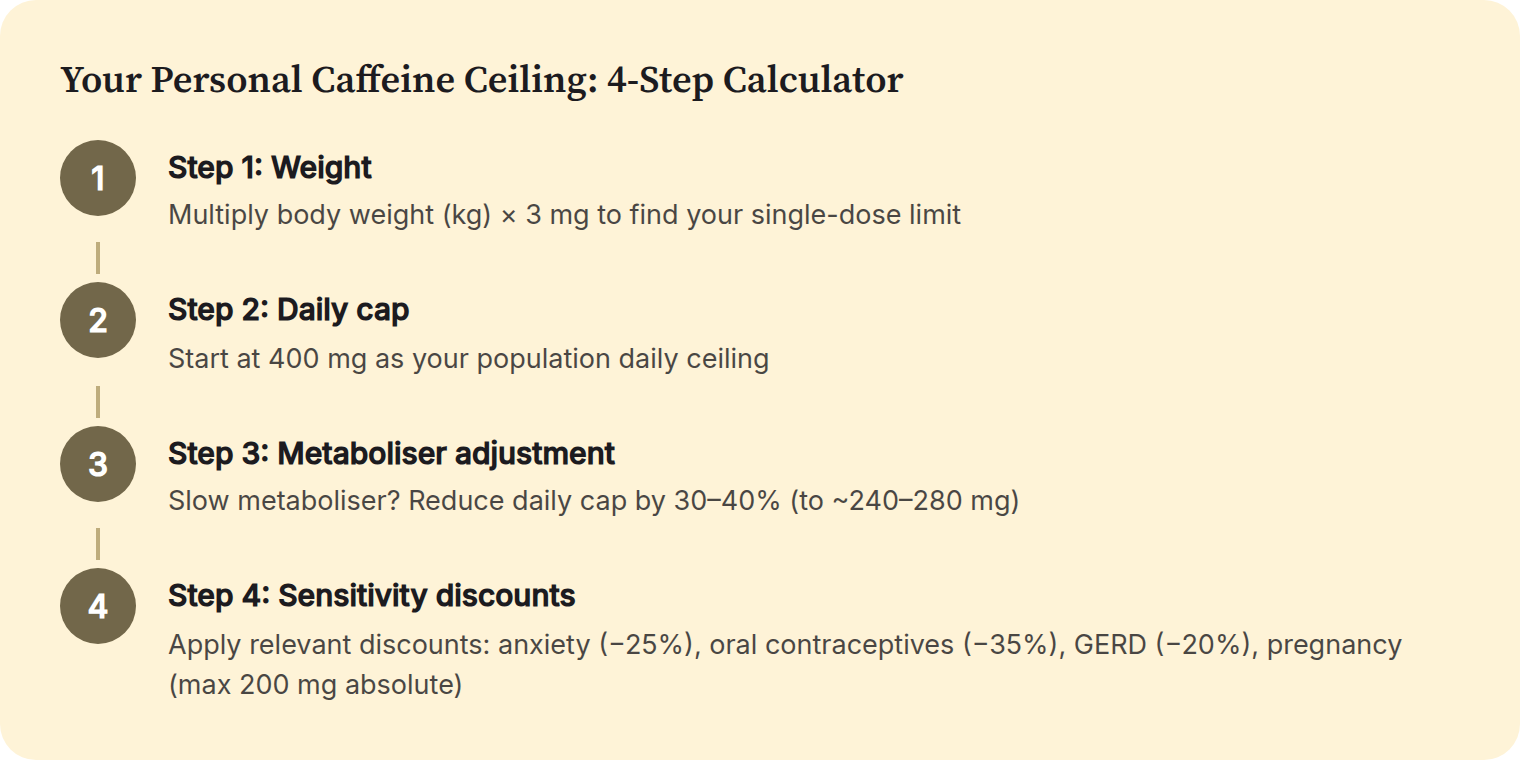
Infographic from the guide

Who it's for

A health-conscious adult who drinks coffee regularly and wants to make sure their habit is helping, not hurting, them. They enjoy coffee and probably already drink one to several cups a day, but they have started second-guessing themselves after reading conflicting headlines about caffeine and health. They worry they are either drinking too little to get real benefits or too much and quietly damaging their heart, sleep, or anxiety levels without realising it.

Questions

Does decaf coffee have any of the same health benefits?
Yes, more than most people expect. Many of coffee's positive associations—particularly for liver health and type 2 diabetes risk—appear in decaf drinkers too, which suggests a lot of the benefit comes from antioxidants and other compounds rather than caffeine alone. Decaf is a genuinely reasonable option, not a consolation prize.
Is it bad to drink coffee first thing in the morning?
Not inherently, but there is a reasonable argument for waiting 60–90 minutes after waking, since cortisol is naturally high in that window and caffeine adds less alertness than it would once cortisol begins to drop. The evidence here is weaker than the before-bed timing evidence, so treat it as worth experimenting with rather than a firm rule.
Can I build up a tolerance and need more coffee over time?
Yes. Tolerance to caffeine's stimulant effects develops within a week or two of consistent use, meaning most regular drinkers are largely returning to baseline rather than getting a genuine boost. A one-week break can reset sensitivity, though the withdrawal headaches for the first couple of days are real.
Does coffee dehydrate you?
Not meaningfully at normal intake levels. Coffee has a mild diuretic effect, but the fluid in the coffee itself more than offsets it for most people drinking 3–4 cups. The dehydration concern is largely unsupported by current evidence at typical intake amounts.
Does the type of coffee maker change the health picture?
It can. Unfiltered coffee—French press, boiled coffee—contains cafestol and kahweol, compounds that raise LDL cholesterol. Paper-filtered drip coffee removes most of both. If you drink a lot of French press, that is worth factoring in, especially if you already have raised cholesterol.