How Do I Price a Productized Service So I Stop Trading Hours for Dollars?
Stop anchoring your price to your time. Here's how to set a flat fee based on outcome value, test it, and actually keep more of what you earn.
Short answer
Stop anchoring your price to your hours and start anchoring it to the outcome your client gets. Pick one clear deliverable, research what that outcome is worth to the buyer, and set a flat fee that reflects that value — not your time. Test the price by raising it until roughly one in three prospects says no; that's your market floor. Package the scope tightly so faster delivery earns you more, not less.
Why Getting Better at Your Job Makes You Earn Less
The better you get, the faster you finish. If you're billing by the hour, faster means less money. So you have a direct financial incentive to stay slow and never quite master anything. That's a bad deal for you and a strange one for your client.
Productized pricing breaks that logic. You charge for the thing delivered, not the clock time it took. If you've spent three years getting fast at writing homepage copy, that speed is yours to keep — as profit, not as a penalty.
What Productized Pricing Actually Means
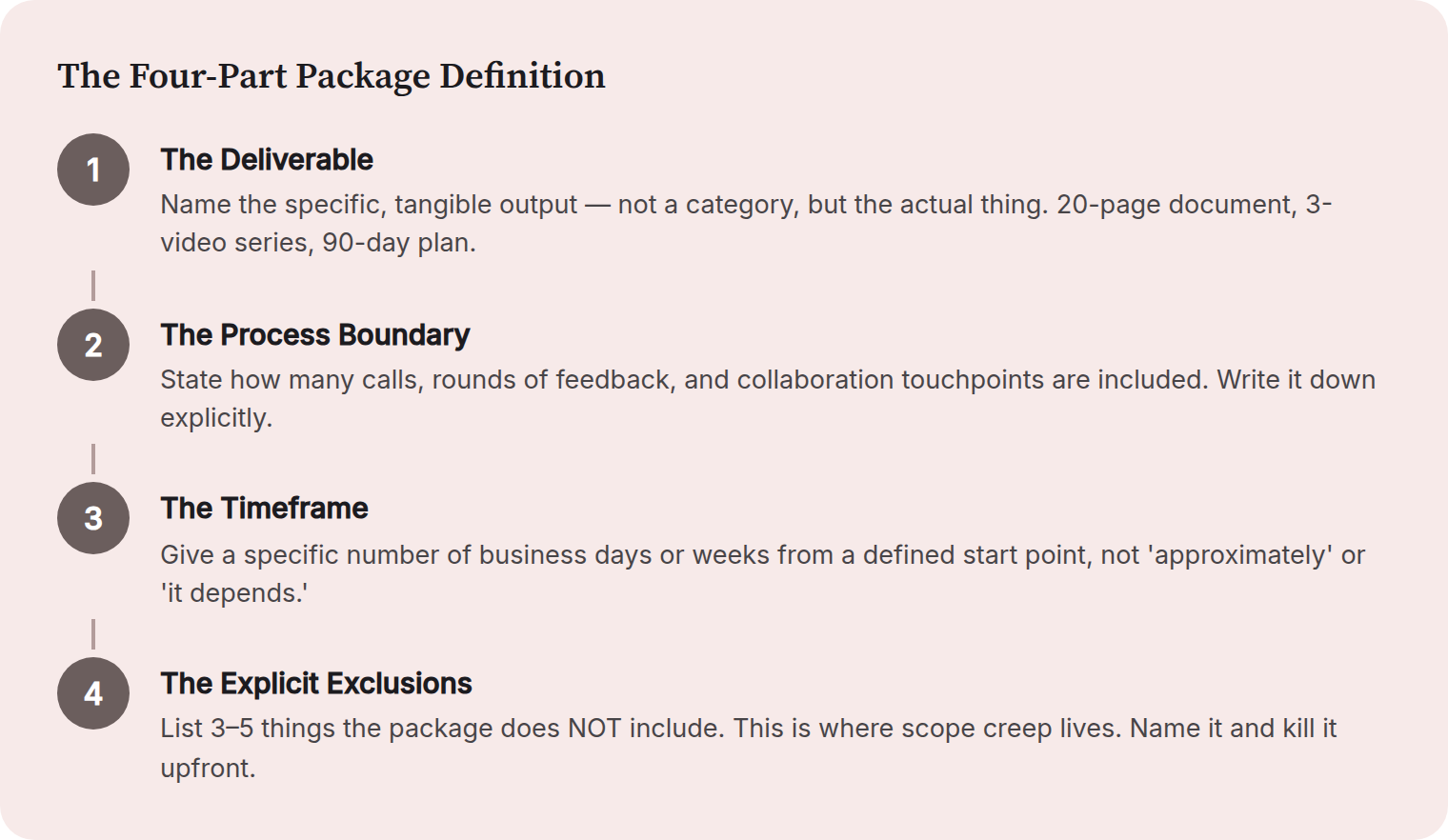
One deliverable. One price. No negotiation on scope. Each offer is fully defined before money changes hands. The client knows what they're getting. You know what you're building. Neither of you is guessing whether revision rounds are included or whether a strategy call is extra.
That clarity is what makes the price defensible. Without it, scope creeps, the client asks for 'just one more thing,' and you either say yes and lose margin or say no and feel guilty.
A Real Example With Numbers
A copywriter I know — call her Sara — charged $75 an hour for website copy. A typical homepage took eight hours, so she walked away with roughly $600. Then a client mentioned that her new copy had doubled his demo request rate. His average contract value was $8,000. That conversation was uncomfortable math.
Sara repackaged her offer as a 'Homepage Story' — one page, one price, two revision rounds, delivered in five business days. She set the price at $1,200. Same work, roughly. But because the scope was defined and the timeline was firm, she got faster. Within two months she was delivering in three to four hours. Her effective hourly rate went from $75 to over $300. And clients stopped haggling because there was nothing to haggle about.
The shift that made it work
Sara stopped describing what she did (writing homepage copy) and started describing what the client got (a homepage that explains what you sell, who it's for, and why it beats the alternative — in five days). Buyers pay for outcomes. They tolerate paying for tasks.
The Three Inputs for Setting Your Flat Fee
- Outcome value. What is the result of your work worth to the buyer? If your SEO audit helps a client rank for terms driving $50,000 in annual revenue, your work is closer to $5,000 than $500. You don't capture all of that value — but knowing the number gives you a ceiling to work down from, not a floor to creep up from.
- Market comps. What are other productized providers charging for something similar? An hour of research across competitor sites and freelance communities tells you whether your number is in the same zip code as reality.
- Your minimum viable margin. What do you need per project for this to be worth running? Include delivery time, client management, sales, admin, overhead, and taxes. If a project takes four hours of work plus two of back-and-forth, your minimum isn't your rate times four.
Start with outcome value, reality-check against comps, confirm it clears your minimum. The number that satisfies all three is your starting price — emphasis on starting.
Four Mistakes That Keep Productized Services Stuck at Freelancer Rates
- Vague scope. 'Social media management' is not a product. 'Eight Instagram posts per month, written, designed, scheduled, and reported on' is a product. Vague scope lets clients fill the gap with their own expectations, which are always larger than yours.
- No anchor price. If you don't show a price before the sales call, you walk into a negotiation with no position. Put your price on the page.
- Discounting on demand. Every time you drop your price because someone pushed, you teach the market that your price is negotiable. 'The scope doesn't change, but I'm happy to discuss a payment plan' is a complete sentence.
- Hiding the price. Post it anyway. Clients who'd never pay your rate self-select out before wasting your time on a call. That's not lost business — that's saved hours.
How to Test and Raise Your Price
If everyone says yes, your price is too low. If almost everyone says no, the offer probably isn't clear enough. You're looking for roughly two out of three qualified prospects converting. That one rejection tells you where the real floor is.
Your price is a hypothesis. Every proposal you send is a data point. Stop treating it like a confession and start treating it like an experiment.
To test a new price, send the next five proposals at the new number. If two or three convert, hold it for another five. Raise in 10–20% increments. You'll know when you've pushed too far.
One Thing to Do Before the End of the Week
Pick your most repeatable service. Write three sentences describing the outcome it produces for the client — not what you do, what they get. Set a flat fee using the three inputs. Put it in your next proposal template or on your website.
Run one productized offer alongside your hourly work. Most people find the packaged offer attracts better clients and generates less back-and-forth almost immediately. The income anxiety of freelancing is mostly about unpredictability. A defined offer at a defined price is the first real step toward revenue that doesn't feel like a surprise every month.
Questions people also ask
What if my clients always have different needs — can I still productize?
Most 'every client is different' situations have more in common than they appear. Look at your last ten projects and find the 70% that was identical. Package that core, and price the variations as flat-fee add-ons. You don't have to productize everything — even one anchor package changes the conversation.
Should I charge more for rush delivery?
Yes. A rush fee of 25–50% on top of your standard rate is normal in most service businesses. State it clearly in the offer so clients know before they ask, not after they've already told you the deadline is tomorrow.
How do I handle a client who wants to negotiate the price down?
Reduce scope rather than price. 'I can't do it for less, but here's a smaller version at that budget.' This keeps your per-unit margin intact and gives the client a real choice rather than a discount that undermines every future conversation.
Is it okay to have different price tiers?
Two or three tiers work well. More than that and clients stall trying to figure out which one fits. Tiers should differ by scope or delivery speed — not by how much care you put into the work.
How do I explain a price increase to existing clients?
Be direct and give four to six weeks' notice. Something like: 'My pricing changes on [date]; your current rate is locked until then.' Most good clients respect the transparency. The ones who don't were probably undervaluing you anyway.
The Full Guide
Stop Billing Hours. Start Pricing Productized Services for Real Profit.

- A fill-in-the-blank pricing calculator that runs all three inputs — outcome value, market comps, and minimum viable margin — and outputs a starting flat fee
- Three fully worked productized offer examples across design, consulting, and writing, with scope definitions, pricing rationale, and actual proposal language
- A scope-creep prevention checklist and a word-for-word script for handling price objections without discounting