
Stop Charging by the Hour cover
The full guide · 23 pages · PDF

Stop Charging by the Hour

A Practical Guide to Pricing Your Productized Service So Clients Pay for What You Deliver, Not How Long It Takes

Stop anchoring your price to your hours and start anchoring it to the outcome your client gets. Pick one clear deliverable, research what that outcome is worth to the buyer, and set a flat fee that reflects that value — not your time. Test it by raising your price until roughly one in three prospects says no; that's your market floor, not your ceiling. Package the scope tightly so faster delivery earns you more, not less.

Get the guide — free

What's inside

01
The Mindset Shift: Why Your Time Is the Wrong Unit of Measurement
Hourly pricing structurally punishes expertise — the better you get, the less you earn per engagement.
02
Defining the Deliverable: How to Scope a Package So Tightly Clients Can't Haggle
Every package needs four components: deliverable, process boundary, timeframe, and explicit exclusions.
03
Value-Based Pricing in Practice: A Step-by-Step Method for Finding What the Outcome Is Worth
Every service has an economic outcome — revenue up, costs down, time recovered, or risk reduced. Find it before you name a price.
04
Worked Scenarios with Real Numbers: Three Service Types Priced from Scratch
Your floor (not your gut) sets the minimum. If the value-based number comes in below your floor, the floor wins.
05
Pricing Tiers and Anchoring: How to Build a Good-Better-Best Structure That Lifts Average Order Value
Three tiers work because price feels relative, not absolute. The premium tier makes the core feel reasonable.
06
Your Pricing Page Template: Exact Language, Layout, and What to Never Put on It
The outcome paragraph comes before the price — always. Value first, number second.
07
Handling Objections and Discount Requests Without Caving — Plus Your 90-Day Price-Test Tracker
Objections are requests for more information, not refusals. Go back to value before you touch the price.

Plus 2 fill-in worksheets and a 12-step action checklist.

A page from the guide
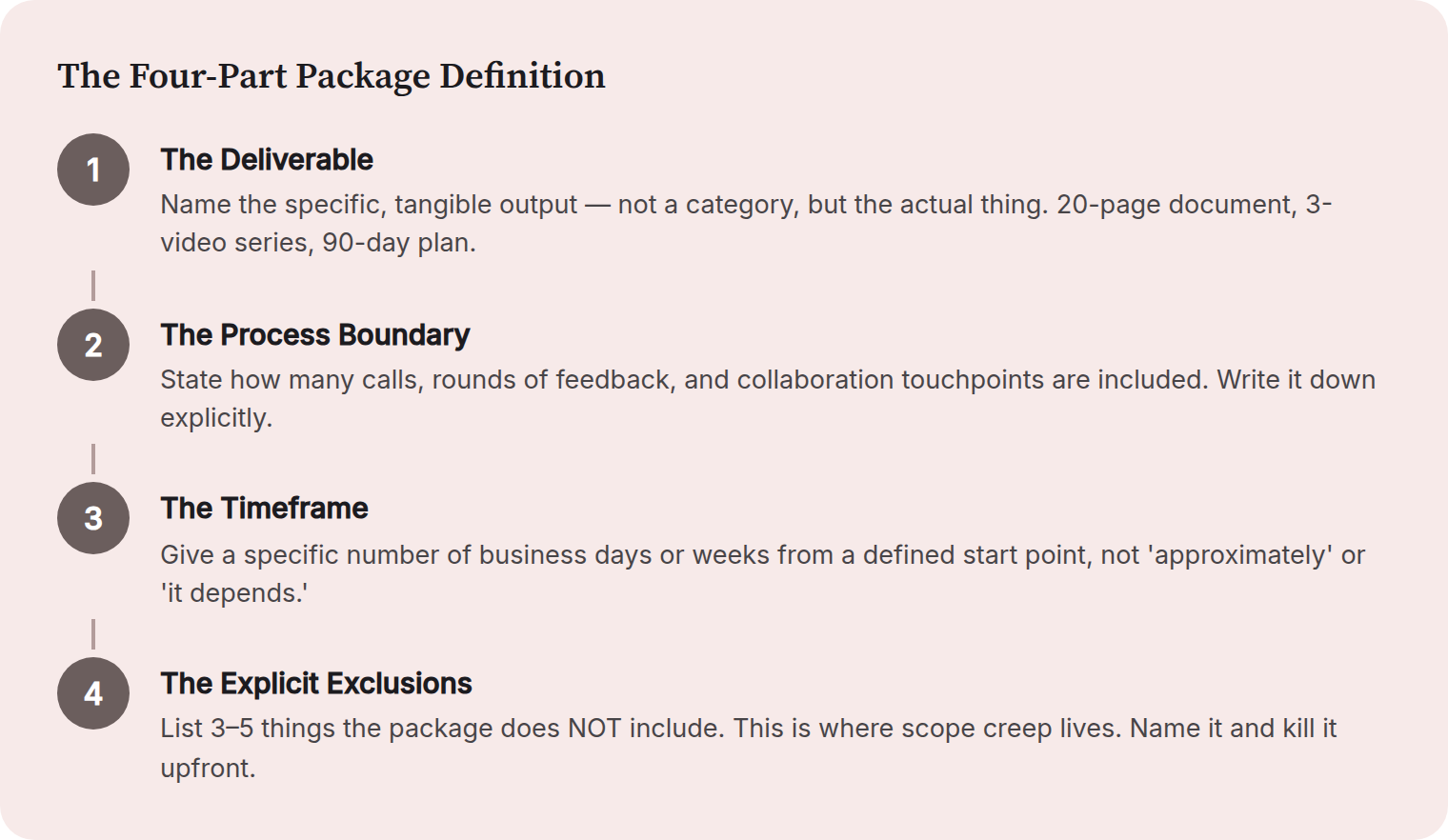
Infographic from the guide

Who it's for

A freelancer or consultant who has packaged their service into a defined offer but is still quoting by the hour or undercharging because they don't know how to anchor the price to value instead of time. They've done the hard work of niching down and defining a repeatable service, but every time a client asks 'what do you charge?' they panic and default to an hourly rate or a gut-feel project fee. They're worried they're leaving money on the table, scaring off good clients with inconsistent pricing, and still feeling the income anxiety of a freelancer even though they're trying to run a real business.

Questions

What if my clients always have different needs — can I still productize?
Most 'every client is different' situations have more in common than they appear. Look at your last ten projects and find the 70% that was identical. Package that core, and price the variations as flat-fee add-ons. You don't have to productize everything — even one anchor package changes the conversation.
Should I charge more for rush delivery?
Yes. A rush fee of 25–50% on top of your standard rate is normal in most service businesses. State it clearly in the offer so clients know before they ask, not after they've already told you the deadline is tomorrow.
How do I handle a client who wants to negotiate the price down?
Reduce scope rather than price. 'I can't do it for less, but here's a smaller version at that budget.' This keeps your per-unit margin intact and gives the client a real choice rather than a discount that undermines every future conversation.
Is it okay to have different price tiers?
Two or three tiers work well. More than that and clients stall trying to figure out which one fits. Tiers should differ by scope or delivery speed — not by how much care you put into the work.
How do I explain a price increase to existing clients?
Be direct and give four to six weeks' notice. Something like: 'My pricing changes on [date]; your current rate is locked until then.' Most good clients respect the transparency. The ones who don't were probably undervaluing you anyway.