How Do I Negotiate an Appraisal Without Burning Any Bridges?
Go in with evidence, not emotion, and frame the talk as a question rather than a demand. Here's exactly how to do it.
Short answer
Bring documented evidence — specific results, market data, and scope comparisons — rather than personal need, because facts don't trigger defensiveness the way feelings do. Frame the conversation as asking for your manager's input on what would move you forward, which keeps them on your side rather than across from you. Agree on a concrete next step before you leave, even if the answer isn't yes yet, so nothing feels unresolved.
Why this conversation feels scarier than it actually is
Most people walk into an appraisal carrying a low-grade fear that asking for more will be remembered against them. So they say nothing, accept whatever number lands on the table, and spend the next twelve months quietly resentful.
Here's what I've seen repeatedly: managers almost never remember the person who asked calmly and came prepared as a problem. They remember the person who was flustered or vague. The ask itself is not the risk. How you make it is.
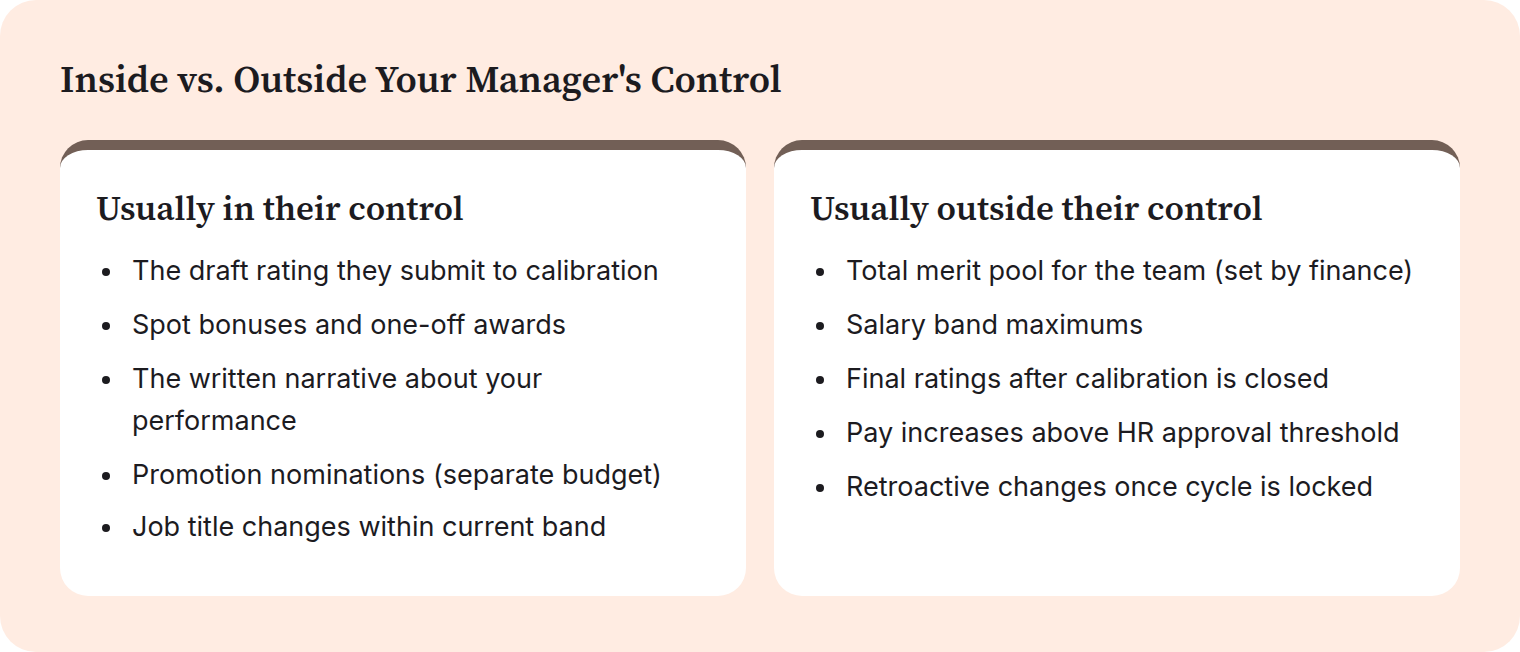
The shift that makes everything easier: evidence over emotion
The moment you bring feelings into the room — 'I feel like I deserve more' or 'I've been here three years and nothing has changed' — you've handed your manager a problem they can't solve objectively. Swap feelings for facts and the dynamic shifts. Facts don't have an ego.
The three types of evidence that actually move the needle: your output record with real numbers, a comparison of your current responsibilities against the job description one level above yours, and market salary data from a credible source like Glassdoor, LinkedIn Salary, or an industry survey. One of these is decent. All three together is a proper case.
How Maya turned a 2% standard raise into 8% using three data points
Maya was a mid-level marketing manager at a software company. The standard raise pool was 2–3%. She also knew she'd spent the year running a product launch that sat in the remit of someone a full band above her.
Before the meeting she put together three things: a one-page summary showing £1.4 million in pipeline generated and a launch delivered six weeks early; a side-by-side of her job description against the Senior Manager spec — she was already covering about 70% of that role; and salary data from two sources showing the median for her actual responsibilities was roughly 14% above what she earned.
In the meeting she said: 'I've been thinking about where I am relative to the team and the market, and I'd love your perspective on whether my current scope is reflected in my grade — and if not, what the path looks like to close that gap.' Then she shared the one-pager. Her manager couldn't approve a title change on the spot, but the documented evidence made it easy to escalate to HR. Six weeks later: an 8% increase and a formal note that she was being considered for the next band. Her relationship with her manager improved, because he saw someone who handled a hard conversation professionally.
Phrases that work — and the ones that reliably backfire
- Works: 'Based on what I've put together, I'd love your input on whether there's a case for revisiting my grade.'
- Works: 'I want to make sure I understand what the next level looks like — can we talk about what would move me there?'
- Backfires: 'I know the budget is tight, but...' — you've conceded before you've said anything.
- Backfires: 'I feel like I've been underpaid for a while.' — feelings, not evidence.
- Backfires: 'I just need a bit more to cover my costs.' — your personal finances are not a business case.
Give your manager a heads-up
A few days before the review, say: 'I've been doing some thinking about my role and scope and I'd like to spend some time on that in our meeting.' This gives them a chance to check what's actually possible before they're sitting across from you.
How to end the meeting so the door stays open
If you leave without a next step, the conversation evaporates and any follow-up feels like chasing. Before you stand up, agree on something specific: a date by which your manager will come back to you, or clarity on what needs to happen for the case to progress — budget sign-off, an HR conversation, a formal job-band review.
Then send a short email within 24 hours. Not pressure — just a summary of what was discussed and the next step you agreed on. It creates a paper trail without feeling aggressive, and it shows you're organised. After that, genuinely let it go for the agreed period. One polite check-in if the date passes with no word. That's it.
The version of you that handled a difficult conversation well and then got on with the job is far more memorable — in the right way — than the version who either said nothing or wouldn't drop it.
Questions people also ask
What if my manager says the budget genuinely doesn't allow for more this year?
Ask what would need to be true for the conversation to go differently at the next review cycle — specific milestones, a different budget window, or a title change that opens a new pay band. Get those criteria written down, even informally, so you have something concrete to work toward.
Should I mention that I've been approached by another company?
Only if it's completely true and you'd genuinely consider leaving. If it is true, frame it as information rather than a threat: 'I've had some conversations externally and it's made me want to be intentional about my path here.' Bluffing this once will follow you.
How do I find reliable market salary data without paying for a subscription?
Glassdoor, LinkedIn Salary, and Levels.fyi are free and reasonably current. Cross-reference at least two sources and filter by your city, sector, and experience level. If your professional association publishes an annual salary survey, that carries particular weight with HR.
My manager is supportive but says it's out of their hands. What do I do?
Ask if they'd be willing to advocate on your behalf, and offer your one-page summary so they have something concrete to bring to HR or their own manager. A manager who believes your case is reasonable will often push harder when you make it easy for them.
The Full Guide
Get the Raise You Deserve Without Burning Any Bridges

- A ready-to-use one-page evidence template you can fill in before your review meeting
- Three fully worked appraisal scenarios — including what to say when the answer is no, when you're asking for a title change, and when you're a first-time manager making the case upward
- A pre-meeting and post-meeting checklist so nothing slips through and the conversation has a clear paper trail