
The Weekly Financial Review System cover
The full guide · 20 pages · PDF

The Weekly Financial Review System

How to stop losing track of your money every month — without turning budgeting into a second job

A weekly financial review works when it is short, scheduled, and tied to a specific trigger — not willpower. Set aside 20 minutes every Sunday, pull up one number (your 'spending so far this week' total), compare it to a simple weekly spending target, and flag any category that is off before it becomes a monthly disaster. The key is not tracking everything perfectly but catching drift early, when a $40 overspend in dining is still fixable rather than a $200 monthly blowout you discover too late.

Get the guide — free

What's inside

01
Why Weekly Beats Monthly: The Math of Catching Drift Early
Monthly reviews show you the damage after it is done. Weekly reviews give you time to actually respond.
02
Setting Your Weekly Spending Target from Your Real Take-Home Pay
Your weekly target must come from what remains after fixed costs and savings are already removed — not from your full income.
03
The Four-Category System: Fixed, Flex, Fun, and Float
Four categories — Fixed, Flex, Fun, Float — cover everything without requiring the obsessive tracking that kills most systems after two weeks.
04
The System in Action: A Full Month of Weekly Reviews with Real Numbers
An overspent week is not a failed month. It is just information. The correction happens the following week, not at month-end when it is too late.
05
The 20-Minute Sunday Review and the Wednesday Rescue Plan
The review must be scheduled in your calendar as a recurring event. Motivation is unreliable. A calendar slot is not.
06
Failure Modes, Fixes, and the Month-End Wrap-Up
The most common reason people abandon a system is not laziness — it is the shame spiral. An imperfect review done late is always better than no review.

Plus 2 fill-in worksheets and a 12-step action checklist.

A page from the guide
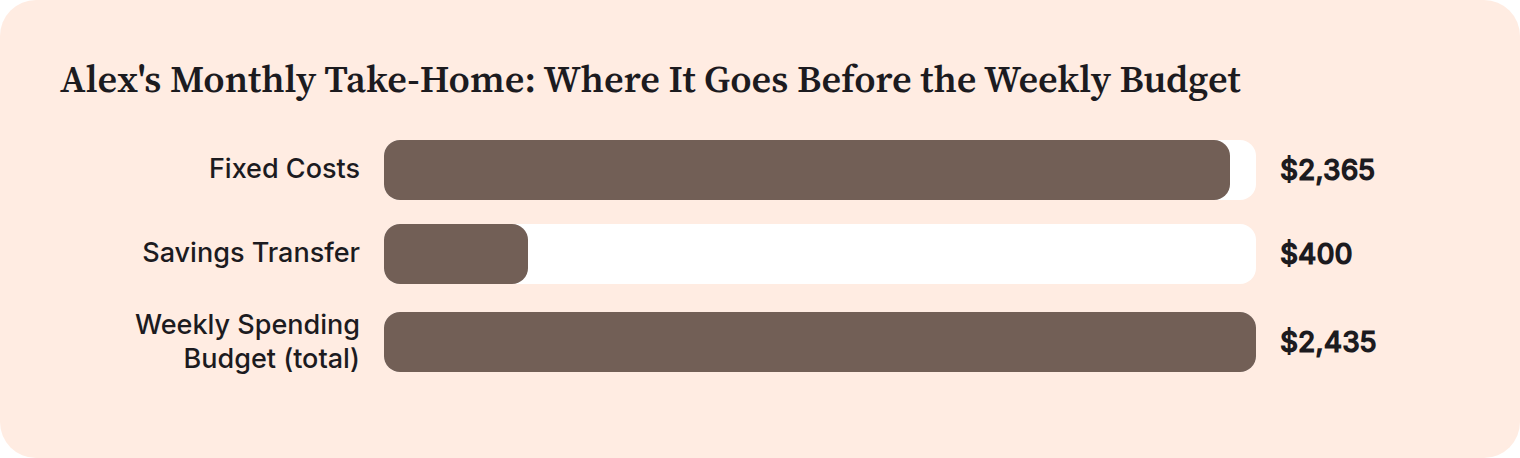
Infographic from the guide

Who it's for

A person in their late 20s to early 40s who earns a decent income but consistently reaches the end of the month confused about where their money went. They have tried budgeting apps and spreadsheets before but always abandon them after a week or two because the system feels like a chore rather than a habit. They are not in crisis, but they notice their savings account barely moves and small purchases seem to silently drain their account, leaving them anxious and slightly ashamed every time they check their balance.

Questions

What if my income varies each month and I can't set a fixed weekly target?
Base your weekly target on your lowest realistic monthly income, not your average. When you earn more in a given month, treat the extra as a deliberate allocation — savings, debt paydown, or a specific want — rather than expanding your baseline spending. This keeps the review consistent even when income isn't.
Do I need to include credit card spending in my weekly total?
Yes, absolutely. The biggest trap is tracking only what leaves your bank account and ignoring what's accumulating on a card. Pull both. If your bank and credit card are different institutions, check both apps during your Sunday review. It adds two minutes and prevents the most common blind spot.
How do I handle irregular big expenses like car repairs or annual subscriptions?
Keep a simple running list of known irregular expenses and estimate a monthly average. A $600 car repair happens roughly once a year, so budget $50 a month toward it as a fixed cost before calculating your flexible pool. When the expense hits, it doesn't blow up your weekly target.
I share finances with a partner. How do we do this together without it becoming an argument?
Keep the review short and focused on numbers, not decisions. Agree on the weekly target together before the first review, so the Sunday session is just a comparison, not a negotiation. If something needs a real conversation, schedule it separately from the review itself.
How long before this actually changes my spending habits?
Most people start catching drift in week two and making real adjustments by week three. The habit itself usually feels automatic by week six or seven — about the same time it stops feeling like a chore and starts feeling like just checking the weather.