Where Should Beginners Invest Money to Get Good Returns?
Overwhelmed by investing options? Here's where most beginners should actually put their first dollars—and why it works.
Short answer
For most beginners, the best starting point is a low-cost index fund inside a tax-advantaged account like a Roth IRA or a workplace 401(k). Index funds spread your money across hundreds of companies automatically, which reduces risk without requiring you to pick stocks. A total market or S&P 500 index fund from Vanguard, Fidelity, or Schwab is a solid, evidence-backed choice. Start with whatever you can afford—even $25 a month—and increase it over time.
Why beginners lose money before they even start
The most common beginner mistake isn't picking a bad stock. It's waiting. Money sitting in a standard savings account earning 0.01% interest is quietly losing ground to inflation every single year. That nagging feeling that you should be doing something smarter? It's correct. But the good news is that the right move here is simple, boring, and backed by decades of evidence. You don't need to be clever. You just need to start.
The second trap is the exciting stuff—crypto tips from a coworker, a hot stock someone mentioned at a party, or a YouTube ad for an investing course that promises to teach you to 'trade like a pro.' That path tends to end badly for beginners. Not because you're not smart enough, but because you'd be competing with people who do nothing else all day. I'd skip it entirely.
The account type that gives your money a tax advantage from day one
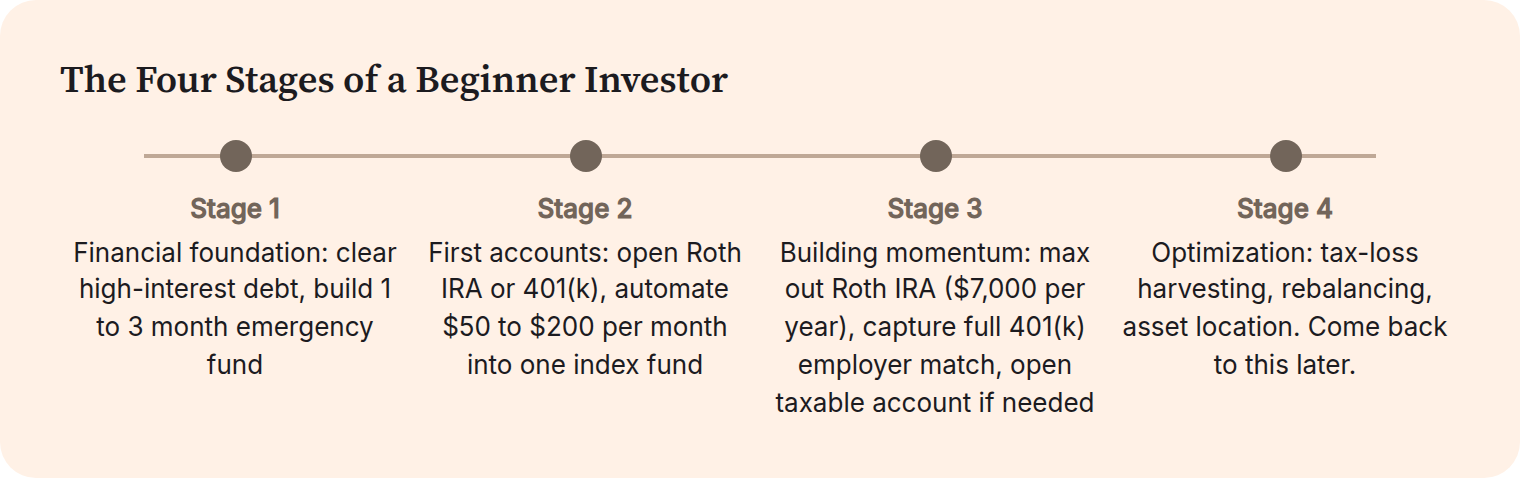
Before you pick any investment, you want to put it inside the right container. Think of a Roth IRA like a special box. You put money in, it grows for decades, and when you take it out in retirement, you pay zero tax on the gains. Zero. That's a significant deal. The 2025 contribution limit is $7,000 per year if you're under 50.
If your employer offers a 401(k) with a match, do that first. A match is free money—literally your employer adding to your account just because you contributed. A common setup is 50% match on up to 6% of your salary. If you earn $50,000 and contribute 6%, that's $3,000 from you and $1,500 free from your employer. Don't leave that on the table.
Priority order for most beginners
1. Contribute enough to your 401(k) to get the full employer match. 2. Open a Roth IRA and max it out if possible ($7,000/year). 3. Go back and add more to your 401(k) if you have more to invest.
Index funds in plain English
An index fund is just a basket. An S&P 500 index fund holds tiny pieces of 500 of the largest American companies—Apple, Microsoft, JPMorgan, Johnson & Johnson, and 496 others. When you buy one share of the fund, you own a sliver of all of them at once. If one company has a terrible year, it barely moves the needle because 499 others are still in there.
The reason experts love index funds isn't complicated. Study after study shows that most actively managed funds—where a professional picks stocks for you—fail to beat a simple index fund over 10 or 20 years once you account for their fees. Vanguard's VTSAX (total US market) charges 0.04% per year. Some actively managed funds charge 1% or more. That gap compounds into real money over time.
What $100 a month actually looks like
The S&P 500 has returned roughly 10% per year on average over the long term, before inflation. Let's use a more conservative 8% to account for real-world variability.
- After 10 years at $100/month: roughly $18,300 total invested, account value approximately $18,400 (yes, almost flat—this is why time matters)
- After 20 years at $100/month: $24,000 invested, account value approximately $59,000
- After 30 years at $100/month: $36,000 invested, account value approximately $150,000
The first decade feels slow. That's normal, and it discourages a lot of people into quitting. But the math is exponential—the last ten years of that 30-year window produce more growth than the first twenty combined. The single biggest variable isn't which fund you pick. It's how early you start.
Three mistakes that quietly kill returns
1. Selling when the market drops
Markets fall. Sometimes 20%, sometimes 40%. Every significant drop in history has eventually recovered, and the people who sold at the bottom locked in losses permanently. If you're in your 20s or 30s, a market crash is actually a good thing—your monthly contributions buy more shares at lower prices. The goal is to ignore the noise and keep contributing.
2. Waiting for the 'right time'
There is no right time. Researchers at Charles Schwab studied what would have happened if someone invested $2,000 every year at the absolute worst possible moment—always at the market's annual peak. After 20 years, they still came out significantly ahead of someone who never invested at all. Timing the market is a losing game. Time in the market wins.
3. Picking high-fee funds
When you're choosing a fund, look at the expense ratio—that's the annual fee expressed as a percentage. Anything above 0.5% is worth questioning. Anything above 1% is almost certainly not worth it for a basic index fund. Fidelity even offers some index funds with a 0% expense ratio. Fees are the one thing in investing you can control completely, so keep them low.
How to open your first account in under 15 minutes
I'd start with Fidelity or Schwab if you're opening a Roth IRA—both have no account minimums, strong customer service, and good fund options. Vanguard is excellent too, though their interface is a bit older.
- Go to Fidelity.com or Schwab.com and click 'Open an account'
- Choose 'Roth IRA' as the account type
- Enter your personal info and Social Security number (it's secure—this is a regulated financial institution)
- Link your checking account and transfer your initial amount
- Search for 'FZROX' (Fidelity's zero-fee total market fund) or 'SWTSX' (Schwab's equivalent) and buy shares
- Set up automatic monthly contributions so you never have to think about it again
That last step matters more than anything else. Automating contributions removes the decision from your hands. You won't talk yourself out of investing during a stressful month, and you won't skip it when something shinier catches your attention.
What to do once your first investment is set up
Genuinely? Don't touch it. Check it once a year to make sure your contribution amount still makes sense as your income grows. If your employer adds a 401(k) match you weren't using, sign up. As your salary increases, bump up your monthly contribution—even by $25 at a time. Otherwise, let it sit.
The boring version of investing—index funds, automatic contributions, leave it alone—has outperformed the exciting version for most people over most time periods. You don't need a financial advisor, a hot tip, or a complicated strategy. You need a Roth IRA, a low-cost index fund, and a standing bank transfer. That's actually it.
'The stock market is a device for transferring money from the impatient to the patient.' — Warren Buffett
Questions people also ask
How much money do I need to start investing?
Fidelity and Schwab have no minimum to open a Roth IRA, and some of their index funds let you buy in for $1. You don't need a large sum. Starting with $25 or $50 a month beats waiting until you have 'enough.'
Is a Roth IRA better than a traditional IRA?
For most people in their 20s and 30s who expect their income to grow, yes. You pay taxes on the money now at a lower rate, and all future growth comes out tax-free in retirement. If you're in a very high tax bracket now, a traditional IRA might be worth comparing.
What if my employer doesn't offer a 401(k)?
Open a Roth IRA directly with Fidelity, Schwab, or Vanguard and contribute there. Self-employed? A SEP-IRA or Solo 401(k) lets you contribute much larger amounts and is worth looking into.
Should I pay off debt before investing?
High-interest debt—anything above roughly 7% interest, like credit cards—should generally be paid off before investing outside of your employer match. Lower-interest debt like student loans or a car loan at 4% is a closer call, and many people do both simultaneously.
What happens to my investment if the company I invest through (like Fidelity) goes bankrupt?
Your investments are held separately from the brokerage's own assets and protected by SIPC insurance up to $500,000. A brokerage going bankrupt doesn't mean your investments disappear—they're yours, not theirs.
The Full Guide
Where Should Beginners Invest Money to Get Good Returns?
- A step-by-step account setup checklist with screenshots for Fidelity, Schwab, and Vanguard so you don't get stuck on a single screen
- Three worked scenarios showing exactly what to do if you have $500 saved, $2,000 saved, or $10,000 saved right now
- A contribution planner template that shows how increasing your monthly amount by $25 increments changes your 20-year outcome