How Do I Structure My LLC to Legally Pay Myself a Salary and Reduce Self-Employment Tax?
Electing S-corp tax treatment for your LLC lets you split profit into a W-2 salary and owner distributions, so you only owe self-employment tax on the salary portion.
Short answer
You reduce self-employment tax by electing S-corp tax treatment for your LLC, which lets you split your income into a reasonable W-2 salary and owner distributions — you only owe self-employment tax on the salary, not the distributions. File IRS Form 2553 to make the election, run actual payroll for yourself at a salary the IRS would consider reasonable for your role, and take additional profit as distributions. This typically saves money once your net profit is reliably above $40,000–$50,000 per year, because below that the payroll costs can outweigh the tax savings.
Why Single-Member LLC Owners Overpay by Default
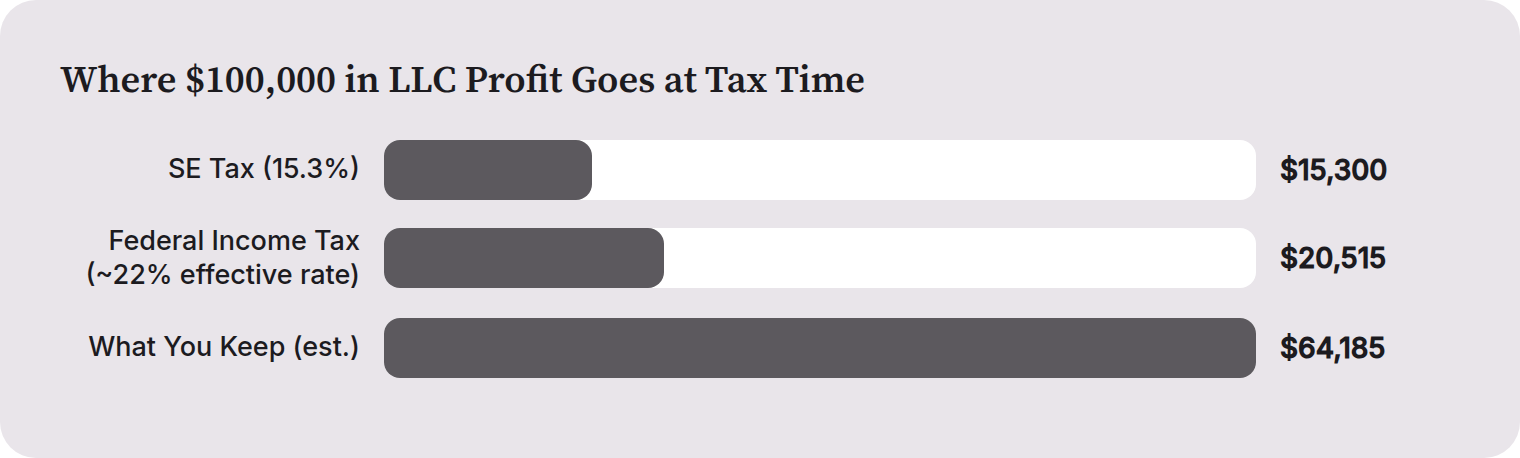
When your LLC has no special tax election on file, the IRS treats it as a 'disregarded entity.' Every dollar of net profit flows to Schedule C, and the IRS considers all of it self-employment income. That means 15.3% self-employment tax on the whole amount — 12.4% for Social Security and 2.9% for Medicare. On $100,000 of profit, that's $15,300 before you even get to income tax.
A regular W-2 employee splits that burden with their employer — each side pays 7.65%. As a sole proprietor you are both sides, so you pay both halves. There is a legal structure that changes this math, and most LLC owners don't find out about it until they've already overpaid for a year or two.
What the S-Corp Election Actually Does
Filing Form 2553 does not turn your LLC into a corporation. Your state registration, operating agreement, and liability protection stay exactly as they are. What changes is how the IRS taxes your income.
Once the election is approved, your profit splits into two buckets. The first is your W-2 salary, paid through actual payroll and subject to the usual payroll taxes. The second is owner distributions — your share of remaining profit paid out to you. Distributions are not wages, so they carry no payroll tax. You still owe ordinary income tax on them, but that 15.3% hit disappears on that portion.
The key word is 'split'
The IRS does not let you pay yourself zero salary and take everything as distributions. You must pay yourself what a reasonable employer would pay someone doing your job. The salary amount is where the IRS focuses its attention.
A Real Numbers Example: $120,000 Net Profit
Say you are a freelance designer netting $120,000 a year. Under default LLC treatment, self-employment tax on the full amount runs roughly $18,360 — though you deduct half of it, so the real net cost is closer to $15,900.
After the S-corp election, you set a reasonable salary of $65,000 and run payroll. Payroll tax on that: $9,945. The remaining $55,000 comes out as a distribution — no payroll tax. Total payroll tax: $9,945 versus $18,360. Gross savings: roughly $8,400. Subtract $500–$1,500 for payroll software and another $500–$1,500 for a CPA to file your S-corp return (Form 1120-S), and you are likely clearing $5,000–$6,000 in real annual savings. At $60,000 of profit, the math gets tight. Run your own numbers before filing anything.
What 'Reasonable Salary' Means and How to Back It Up
The IRS has won cases against S-corp owners who paid themselves $1 salaries while taking six-figure distributions. The rule: pay yourself what you would have to pay a stranger to do your job.
There is no official IRS salary table. I'd start with the Bureau of Labor Statistics Occupational Employment and Wage Statistics database — free, organized by role and geography. Cross-reference with Glassdoor or LinkedIn salary data. Document your sources, the date you checked, and why you landed on your number. If the IRS ever asks, you want a paper trail showing deliberate analysis. A common CPA rule of thumb for knowledge workers: salary should fall somewhere in the range of 40%–60% of net profit, though what market data shows for your specific role matters more than any ratio.
Three Mistakes That Erase the Savings
- Skipping real payroll. Transferring money and calling part of it a salary is not enough. You need an actual payroll run — withholding taxes, remitting them on schedule, generating W-2s at year end. Payroll software handles this; skipping it unravels the whole structure.
- Setting your salary too low. A $20,000 salary on $180,000 of profit is a red flag. The IRS can reclassify distributions as wages, assess back payroll taxes, and add penalties. The savings are not worth the risk of an obviously artificial number.
- Missing the Form 2553 deadline. To have the election apply to the current tax year, you generally need to file by March 15 for a calendar-year LLC already in operation. Miss it and you wait another year. Late-election relief exists but is not guaranteed.
Your Next Three Steps
First, check your numbers against the break-even threshold. If you are consistently netting $50,000 or more after business expenses, the full analysis is worth doing. Below that, revisit when your income grows.
Second, find a CPA who works regularly with small-business S-corps. A one-hour consultation typically runs $200–$400 and will tell you exactly where you stand — including whether your state adds fees that change the math. California and New York, for example, both impose additional costs on S-corps that can meaningfully reduce your net savings.
Third, look into payroll services before you need them. Gusto is commonly used by small S-corps and runs roughly $40–$80 per month for a single employee. Having it configured before your first payroll date is far easier than scrambling after the election goes through.
Questions people also ask
Can I make the S-corp election on an existing LLC or does it need to be a new one?
You can file Form 2553 on an existing LLC at any time. File by March 15 to have it apply to the current calendar year. The IRS also has a late-election relief procedure, but you are better off not relying on it.
Do I need to live in a state that recognizes S-corps for this to work?
Most states follow the federal election automatically, but some — including California and New York — impose additional franchise taxes or fees on S-corps. Check your state's treatment first, because in some cases the state-level cost changes whether the strategy is worth it.
What happens to my quarterly estimated tax payments after the S-corp election?
You still make quarterly payments, but the structure shifts. Payroll taxes are withheld from your W-2 salary and remitted on a regular schedule. You will still owe estimated income tax on your distributions, so quarterly payments continue for that portion. A CPA can help you set the right amounts to avoid underpayment penalties.
Can I still contribute to a Solo 401(k) after making the S-corp election?
Yes. With an S-corp, your employee contribution is based on your W-2 salary, and the business can make employer contributions on top of that. The key difference from a sole proprietorship is that your contribution limits are now tied to your salary rather than your full net profit, so the salary you set also affects how much you can put away.
Does the S-corp election increase my audit risk?
Not meaningfully, as long as you follow the rules — especially the reasonable salary requirement. S-corps are common and the IRS is familiar with them. Where people get into trouble is paying an obviously low salary or skipping actual payroll. Run the structure correctly and it is not an audit magnet.
The Full Guide
Stop Overpaying Self-Employment Tax With Your LLC Today

- A filled-in salary research worksheet with sources and documentation language you can adapt to defend your number to the IRS
- Side-by-side tax savings scenarios at five income levels from $50,000 to $200,000, including state-level cost adjustments for California and New York
- A setup checklist covering Form 2553 timing, payroll service configuration, quarterly deposit deadlines, and year-end W-2 and 1120-S filing requirements