How Do I Save Taxes on International Income?
Earning across borders doesn't mean paying tax twice. Here's how treaties, exclusions, and residency rules can legally cut your bill.
Short answer
The biggest legal levers are tax treaties (which stop the same income being taxed twice), the Foreign Earned Income Exclusion for US citizens abroad, the Foreign Tax Credit, and timing when income lands in which country. Most savings come from understanding which country has the right to tax which income, then claiming every treaty benefit and exclusion you are already entitled to. A one-time residency review with a cross-border tax professional can routinely cut an expat or freelancer's bill by 20–40% — fully above board.
International tax feels confusing because two or three perfectly ordinary countries each believe they have a claim on the same paycheck, and you do not know which one is right. That uncertainty is expensive. Most people I talk to are either overpaying because they did not claim a credit they were entitled to, or underpaying by accident because they missed a filing obligation they did not know existed. Both are fixable.
Why multiple countries think they can tax you
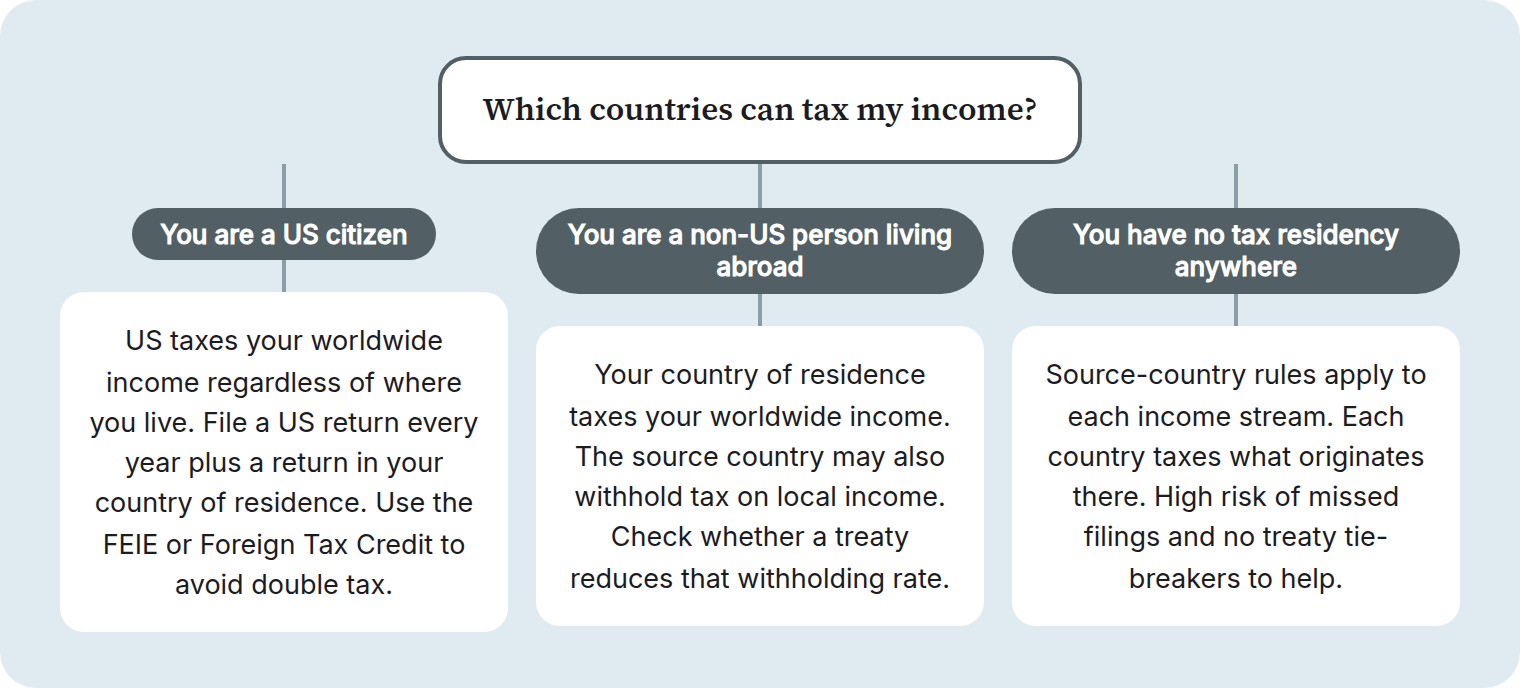
Countries tax income on two different principles: residency and source. Your country of residence typically wants to tax your worldwide income. The country where the income originates often wants a cut too. If you are a US citizen living in Germany doing work for a UK client, you have three countries with at least a theoretical interest in that invoice. Tax treaties exist to sort this out. The US has them with more than 60 countries, and they assign taxing rights rather than eliminate tax. A treaty will often say freelance income is taxed only in your country of residence unless you have a fixed office elsewhere. That one clause can legally zero out a foreign tax bill. Most people never read the relevant article.
A real example with real numbers
A US citizen moves to Portugal and earns $60,000 from a UK-based client as a freelance designer. Without any planning, she might assume she owes US tax on the full amount, some UK tax because the client is British, and Portuguese income tax on top. That instinct would be expensive and mostly wrong.
Here is how it actually works. The US-UK treaty gives the UK no right to tax her income because she performs the work in Portugal and has no fixed base in the UK — the UK is out. Portugal taxes her as a resident, say an effective rate of 15% after deductions, roughly $9,000. For the US: because she qualifies as a bona fide resident of Portugal, she can claim the Foreign Earned Income Exclusion (FEIE), which in 2024 shields up to $126,500 of foreign earned income from US federal tax. Her $60,000 falls entirely under that ceiling. US federal tax on that income: zero. She pays Portugal once and nothing beyond that.
The FEIE is not automatic
You must file Form 2555 to claim the Foreign Earned Income Exclusion. Miss it, and you owe US tax as if you never left. Many people miss it in their first year abroad.
The four mistakes that cost people the most
- Paying tax in both countries without checking the treaty. Many freelancers pay source-country withholding they could have avoided entirely.
- Missing the residency deadline. The FEIE requires either a full calendar year of foreign residence or 330 days outside the US in any 12-month period. People move abroad in March, file in April, and claim the exclusion prematurely — the IRS recaptures it.
- Ignoring the Foreign Tax Credit. If the FEIE does not fully cover your situation — passive income like dividends or rent, for example — the Foreign Tax Credit offsets US tax dollar-for-dollar against foreign tax already paid. Most people know about the FEIE but not the FTC, even though the two often work better together.
- Filing in the wrong order. Filing your US return before your foreign return means you may not know your actual foreign tax liability yet, which changes your credit calculation. File the foreign return first when you can.
Two things you can do this week without hiring anyone
First, look up whether the US has a tax treaty with every country where you earn income or hold residency. The IRS publishes the full list at irs.gov. Find your country, find the article on business profits or independent personal services, and read which country gets to tax your specific income type. It takes an hour and might immediately tell you that a tax you have been paying was never legally required.
Second, pull your prior-year returns and check whether Form 2555 or Form 1116 was filed. If you were living or working abroad and neither form appears, money was likely left on the table. You can amend up to three years of returns to claim credits and exclusions you missed.
When to stop doing this yourself
If you have income in more than two countries, own property abroad, or are considering changing tax residency, I would not go it alone. A cross-border specialist — not a general CPA, but someone who specifically handles international returns — typically charges $800 to $2,500 for a complex return. If they find $8,000 in missed credits, which is not unusual, that fee looks like a reasonable trade. They also catch filing obligations you did not know existed. Foreign financial accounts over $10,000 trigger FBAR reporting (FinCEN Form 114). Foreign corporations or trusts you control trigger additional IRS forms. Penalties for missing these run up to $10,000 per form per year for non-willful violations. Most tax software will not flag any of it.
Before you touch your return, pull this one document
Get your passport and write down every country you spent more than 30 days in during the tax year, with approximate dates. Then list every country that paid you money. That two-column list is the starting point for any honest conversation with a tax professional, and it immediately surfaces where the treaty questions are. Without it, you are guessing. With it, you have a map.
Questions people also ask
Do I have to file a US tax return if I live abroad full time?
Yes. US citizens and green card holders must file a federal return regardless of where they live. The FEIE and Foreign Tax Credit can reduce or eliminate what you owe, but the filing obligation does not disappear because you moved.
Can I just become a tax resident of a low-tax country to avoid US tax?
Not if you are a US citizen — the US taxes based on citizenship, making it one of only two countries in the world to do so. Changing tax residency can significantly reduce your non-US tax burden, but it does not eliminate US filing obligations unless you formally renounce citizenship.
What is the difference between the Foreign Earned Income Exclusion and the Foreign Tax Credit?
The FEIE excludes a set amount of earned income from US taxable income — up to $126,500 in 2024. The Foreign Tax Credit offsets your US tax bill dollar-for-dollar by foreign tax already paid. They work differently, can sometimes be used together, but cannot both apply to the exact same dollars of income.
I have a foreign bank account with about $15,000 in it. Do I need to report it?
Yes. If the combined balance across all your foreign financial accounts exceeded $10,000 at any point during the year, you must file an FBAR (FinCEN Form 114) by April 15, with an automatic extension to October 15. It is filed separately from your tax return through a different system.
My employer withheld foreign income tax from my salary. Does that count toward the Foreign Tax Credit?
Generally yes — foreign income taxes withheld by an employer count toward the credit on Form 1116. Your foreign pay stub or employer tax summary should show the amount withheld.
The Full Guide
Stop Overpaying International Taxes — Keep More Money Legally
- A country-by-country worksheet showing how treaty rules interact for the most common expat and freelancer income combinations
- Annotated walkthroughs of Form 2555 and Form 1116 with line-by-line guidance for typical income types
- A residency timeline checklist to confirm you meet the bona fide residence or physical presence test before claiming the FEIE